Wednesday, January 5, 2011

God is a Meanie II (2 Kings 2:23-24; God Kills Little Children)

Prophet Elisha, Russian icon from first quarte...

Image via Wikipedia

The last passage Numbers 31 was a favorite, but my experience is that this passage is a second favorite of atheists.  Atheist would have us to understand that a Prophet of God had is feelings hurt by a group of unruly kindergartners (or grade schoolers) followed by God's directing two bears to come kill them.  Unfortunately they are not interested in details so they miss the point of this verse they also jump to conclusions about that it is saying. 

As I have said before, "Why is it that atheists are so interested in what an imaginary deity does?"  The level of interest in these God is a Meanie passages from the Bible seem sort of bizarre.  I do not believe for a second that people who are considering faith in God pick up a Bible and come to this passage in particular and say, "Well I was considering that God might exist, but this passage is a deal breaker.  After reading that I am convinced He does not exist."  Really?  Let me suspend my incredulity and assume that there is an atheist that has a genuine interest in this passage. 

From there Elisha went up to Bethel. As he was walking up the path, some small boys came out of the city and harassed him, chanting, "Go up, baldy! Go up, baldy!" He turned around, looked at them, and cursed them in the name of the Lord. Then two female bears came out of the woods and mauled 42 of the children.
2 Kings 2:23-24 (HCSB)

A straight reading of this passage seems to favor the interpretation of the atheists.  I must admit that it seems to describe a serious consequence for a rather trivial offence and it does appear based on the language we are dealing with little children.  Lets dig a little deeper into the passage though to see if first impressions are accurate.

Little Boys"Small Boys" 

The phrase in Hebrew "qtnim norim" is translated in this passage "little boys", "little children", and "little lads."  Depending on which English translation you are using.  Since there is some variation between translations that usually indicates that it is a difficult phase to translate.  Looking elsewhere in the scripture the word "little" refers to size and relative importance in many cases.  When it is used to describe a person it is often used to establish birth order namely the youngest in the family without regard for a specific age.  The word translated "boys" is translated "Young men" (76 times) or "servant" (54 times) and then "child" (44 times), "lad" (33 times), "youth" (6 times).  It would seem that this term is roughly equivalent to adolescent or youth.  

Looking and the instances these two words occur in combination we discover it is used in 6 passages in addition to this one (1 Samuel 16:11; 1 Samuel 20:35; 1 Kings 3:7, 1 Kings 11:17; 2 Kings 5:14; Isaiah 11:6).  The first reference was to David who was tending sheep at the time.  We know that David was able to kill a lion and a bear while he was tending sheep so it is unlikely he was a young child while doing this (see 1 Samuel 17:34-35).  I would put David's age between 15 and 18 at the time.  The second reference was a companion of Jonathan.  He was old enough to retrieve arrows and to return home on his own.  It is difficult to say how old that makes him.  The third reference Solomon uses to describe himself when he is coronated as king.  Solomon was 18-21 when he became king.  The forth reference was to Hadad who escaped, but there are not real clues to his actual age.  The fifth is describing youthful skin.  And the sixth is describing a child leader in poetic (prophetic) language.  So based on the times we can identify and age range it would put our "small boys" in the 15-21 age range. 

Children

"Children"

In verse 24 it says that 42 children were attacked by these bears.  The word children in this case again seems to be a generic child without a specific idea of age.  Two examples would be Daniel 1:4, 17 and 1 Kings 12:8.  In these cases it is translated "young men."  Daniel and his companions were taken to Babylon somewhere between the ages of 12 and 18 to serve in the royal court.  Rehoboam (and young men he grew up with) was a mere 41 years old when he became king (1 Kings 14:21).  So with this term we have an age range of middle childhood all the way up to age 41. 

With that kind of age range it seems to change our understanding of this passage.  It seems that it was a mob of at least 42 young people came out to greet the Prophet of God. 

"Go up, baldy.  Go up, Baldy"

Where is it that these children wanted Elisha to Go up to?  It would seem that they had heard about Elijah (Elisha elder companion) being caught up into the sky.  Elijah was not always popular and I suppose that some were happy to see him go.  I believe that is the message being sent here.  They want Elisha to leave so they are mocking him (and God) in regard to Elijah being caught up to God.  "Baldy" seems a strange insult.  In the culture of the time though "it was using an extreme curse, for the prophet being a young man, may not actually have been bald-headed."1

How serious was this?

So it is possible if not likely that this was not a group of third graders, but rather a mob of adolescents.  But boys will be boys and we cannot make much of them being rude to Prophet of God.  God kills for rudeness. 

First it is not clear that these young people were killed.  They were mauled, but it does not say they were killed.  Is it possible that they were attacked but not killed by these bears?  I would think that it is possible and likely that is what happened here.  If they were killed then why would you not say they were killed.

Second a mob a teens is a serious matter.  I came across this story as I was preparing this post.

This story is eerily similar to this event in the Bible.  These youth were insulting and threatening.  They were age of 15-17.  They were able to subdue a Marine.  Think about if a handful of teens could take down a Marine then a mob of 42 would seem a serious threat to Elisha.  If we were to apply the atheist interpretation of the Bible to this event here then we would have say that the bystander that flashed his gun to scare off the teens and the police that tasered the teens were meanies also.  Again if you are looking for moral high ground it seems very strange to side with these unruly youth over the Prophet of God.


1 Fred H. Wight, Manners and Customs of Bible Lands, (Chicago: Moody press, 1980), WORDsearch CROSS e-book, 96.
Enhanced by Zemanta

Saturday, January 1, 2011

God is a Meanie (Numbers 31; Genocide and Sexual Slavery)

Moab leads Israel into sin, as in Numbers 25:1...

Image via Wikipedia

Another tactic of Atheists is to point to the times that God in His divine wrath judges people in the Bible.  They suggest that God is misogynistic, homicidal, genocidal, tyrant.  One of favorite passages of the Bible for many atheists is Numbers 31.  In this passage the Israelites God commands, "Execute vengeance... against the Midianites."  The Israelite men of war attack this tribe of Midianites kill the men and capture the women and children.  Moses becomes upset because they have allowed the women to live.  He orders the execution of all the women and male children.  The female children are allowed to live.  I have often been told that if you ask someone their favorite passage you can learn a lot about a person.  I am not saying this applies in this case as an atheist does not believe, but it does give pause to think.

My first question to the Atheist would be, why so much vehemence against this ancient text?  I have read several translated ancient texts and have come across stories much more violent and much more unjust than this one appears.  Why so much energy into a fictional story about a mythical God and a people who probably never did any of this anyway?  The only explanations that makes sense to me is either they have doubts about their atheism and pointing to passages like this makes them feel better, they wish to win converts to their way of thinking (faith), or they are engaged in religious like indoctrination of other young atheists. On the last one it is a control technique to create cognitive dissonance through some emotional appeal, then resolve that dissonance by saying you have the answer.  In short this argument is an emotional one more than a rational one.

Now if you ever catch an atheist willing to talk about their favorite passage you will find they are not interested in understanding the background of this passage and only want to judge it on the surface.  Their conclusion is that the passage describes genocide and the sexual slavery of women.  Yet when you try to help them to greater understanding of the passage they will not be bothered by details.  For "free thinkers" they are very narrow-minded.  In case you might find yourself in a discussion about atheists favorite passage, let's take a look at these two claims, but first a little background to the story. 

God told Moses to "Execute vengeance."  For what?  What had the Midianite people done that was so evil that God felt the need to command vengeance?    There is a clue in the passage. 

Yet they are the ones who, at Balaam's advice, incited the Israelites to unfaithfulness against the Lord in the Peor incident, so that the plague came against the Lord's community.
Numbers 31:16 (HCSB)

There are many clues really.  Who is Balaam?  What was his advice? And what was the Peor incident?  Who is Baal Peor?  If we can understand these questions then we can have a better understanding of the events that lead to the execution of this group of people.  I would add one more question "Who are the Midianites?"

Who is Balaam?

Balaam was a man who had a gift of prophecy.  Balak the King of Moab at the time when to Balaam when the Israelites came up out of Egypt (Numbers 22:5).  He desired that the Prophet would curse the Israelites for him, because he felt threatened by them (Numbers 22:6).  Balaam heard from God that he could not curse the Israelites because God had blessed them (Numbers 22:12).  After several attempts by Balak and tempted by the promise of riches Balaam decided to go (2 Peter 2:15).  There is some misunderstanding of Numbers 22:20-22 (NASB) in that it seems as though God gives permission and then becomes angry with Balaam.  The permission to go was given conditionally.  God says "If the men come to call you, rise up and go."  However, Balaam the next morning "Arose and saddle his donkey.."  It seems that Balaam was all too eager to go with them and did not wait on them to call him.  Instead his heart was in to going with them to curse the Israelites and receive his reward.  God Judges Balaam's heart and is angry.

So then Balaam goes to Balak to curse the people of Israel.  He cannot do this since God has blessed them.  In the end Balaam also blesses Israel and curses the kingdoms of Canaan including the Moabites (Numbers 24:17). 

What was his advice?

There is no record of what Balaam said to Balak in Numbers.  However, in the traditional view, explained in Revelation 2:14, Balaam not being able to curse them (being restrained by God) suggested that if the Balak could convince the people to prostitute themselves to the men of Israel and get them to worship foreign gods that they would be able to subvert the will of God.  

What was the  Peor incident?

The plan worked.  The women prostituted themselves (Numbers 25:1) and the Israelites began to align themselves with Baal (God) of Peor (Numbers 25:2-3).  This was a serious matter and had it been unchallenged it could have altered the course of history.  If the Isaelites (God's chosen people) had followed after Baal, God's final plan of redemption would have been thwarted.  So Moses acted swiftly and had those that converted to Baal of Peor killed (Numbers 25:5). 

Who is Baal Peor

Baal Peor is "The Lord of the Opening."  Baal Peor was worshiped with prostitution and other unclean activities involving the openings of the human body (avoiding becoming graphic).  It seems that if you were to pick out a perfect deity to carry out this plan this would be the one.  The warriors (wives and daughters) would be worshiping the deity by giving their bodies in this way.  The men of Israel would be enticed away from God by their sexual appetites. 

Who are the Midianites?

At first it seems confusing; Balak the king of the Moabites and the women of Moab perpetrated this incident.  However, as we dig a little deeper we discover that the Midianites were also aligned with Balak and his plan (Numbers 22:4, 7; Numbers 25:17-18).  However, we cannot say that all Midianites were involved in this plan.

One problem is that Moses was married to a Midianite.  His father-in-law was a Midianite priest (Exodus 2:16, 3:1).  Another problem is that Moses killed every male (Numbers 31:7) and yet about 200 years in future Midian subdued Israel for seven years (Judges 6:1).  How can this be?  The most reasonable explanation is that Moses did not intend for the Israelites to kill all the Midianites (which would have included his own household), but rather the Midianites responsible for the Peor incident.  In fact the passage says as much (Numbers 31:16). 

Conclusion

So in summary Balak goes to the Midianite kings and says we have to get rid of these people they are a threat to us.  He attempts to get a local prophet to pronounce a curse against them because he does not foresee a military victory.  This not being successful they come up with a plan to have women go to seduce the men of Israel and lead them to follow the Baal of Peor.  Presumably the Midianites send a caravan of 5 kings, soldiers along with their wives, daughters, and children.  The wives and daughters, who are old enough, go to the Israelites and entice them to have sex with them.   The plan works and some men of Israel converted to Baal of Peor (Lord of the Opening).  Moses then orders the execution of the men of Israel drawn into this cult.  Later on God commands Moses to tell the Israelites to take retribution against the Midianite caravan that perpetrated this plan. 

Now that we have the background let's take a look at the claim that this was a genocide or taking of sexual slaves.  

The claim that the women spared became sexual slaves makes little sense.  It would seem that all the women of age involved in the plan to entice the men of Israel were executed for their part in this plan.  If the intent was to take sexual slaves then it would not make sense to kill the very women who were willing to give their bodies sexually.  What is more if the women of age (old enough to have sex) were killed that would only leave very young girls.  This would make the claim even more outrageous saying that the Israelites took to pedophilia with little girls.  This claim is outrageous given the restrictions that are clearly laid out in the Bible.  The Jews (because of the Law of God) were very conservative sexually.  Pedophilia does not make sense and is a stretch and perverts the text in Numbers 31.

The claim of Genocide also not make sense.  Moses was close to the Midianite people through marriage.  He did not kill all Midianites as they show up later in the Bible.  It is more likely that Midianites from five cities with five kings agreed to take part with Balak in the plan to perform sexual warfare against the Jews.  And the killing of these Midianites was in the context of the war started by Balak and his Midianite allies. 

In terms of moral responsibility for the children.  I do not want to get into a debate of whether it was right or wrong to kill.  In war the right to kill is clouded by the right to defend oneself.  There have been many men, women, and children killed by warfare.  But to think that these Midianite parents took their children into a war seems outrageous.  They even pressed their adolescent daughters into service as sexual warriors.  It seems that if you are looking for moral high ground siding with the Midianites in this case makes little sense. 

Of course in most cases you will not get someone using this argument to look at the evidence of their claims against God, but at least now you know the whole story. 

God Bless You

Enhanced by Zemanta

Friday, December 31, 2010

Calming the Mind (MIND)

Angry man

Image via Wikipedia

In the last post we talked about Contentment, Acceptance, Loving, and Mindfulness as a way to calm the mind. This is a way to deal with angry and worried thoughts. In this post I want to take this idea further and address Meditation, "I AM Worth it", Nurture, and Diversion as a way to deal with this type of thinking.

Meditation

I have previously posted on the subject of meditation here. Meditation is a contemplative awareness of your own thoughts, others, around you, and most importantly God. It is a deeper way of knowing what is going on. It is a discipline that requires much practice to become good at. Do not expect to meditate once and have calmness as a result. In fact meditation may take as long as three weeks practicing every day before a person starts to see the benefit.

I AM Worth it

OK I cheated on this one. I borrowed "I AM Worth it" from Dr. Redford Williams1. I AM Worth it is an acronym that helps you to remember four important questions.

Important: Is this important?

Appropriate: Is my anger appropriate for the given situation
Modify: Can I change my situation?

Worth it: Is change worth the effort?

Answering "Yes" to all of these would show that you have a problem to solve. Armed with this insight you can focus your energy toward an effective and productive solution. On the other hand answering "No" to any of these would show that you have a problem to cope with. This would mean that you need to find a way to get through and resolve your angry feelings.

Nurture

It is much easier to grow when there is someone to give you instruction, support, and encouragement. His/her nurturance is a powerful influence for growth. What can you do though when you are not with someone who can cheer you through the difficult moment. One thing to do is to develop some short phrases that you can say to yourself that will help you to self-nurture to a better outcome. Some suggestions for self-nurture comments would be:

"I can do this."
"I have faced situations more difficult than this before."
"When I figure this out I will be a better person."
"If I watch my reaction then I am effective in the way I respond"
"Cool Down."
"Take it easy."
"I am almost through this."
"I can to all things through Christ who strengthens me."

Maybe you can think of some of your own. The key to self-nurture statements is repetition. In the heat of the moment you do not want to search for the words. You want the words to come naturally. So identifying the phrases for yourself and practicing them is a good way to remember them.

Diversion

Diversion is a quick way to get the mind off of an angry moment. The way that it works is to find an activity that can get your mind off of things. Some might read a book, listen to music, do housework. For me doing yard-work is a good place to get my mind off of frustrations. A word of caution though; it does not work to divert your action, but leave your mind dwelling on the situation. The goal of the diversion is to get your mind off of the situations so that you calm down. One problem with using diversion all the time is that it becomes the bad habit of avoidance. If you have a problem that you are avoiding you will never solve the problem. Sometimes diversion for the moment, but then return to the problem at hand and addressing it is the best course of action compared to having an angry outburst.

What would it take for you to have a "CALM MIND?" Contentment, Acceptance, Loving, Mindfulness, Meditation, "I AM Worth it," Nurturance, and Diversion only work as you practice them. Having the idea of doing something is not the same as doing it. Trying it once is not the same as doing it well. If you want the have a CALM MIND it will take practice, repetition, and consistency. If make this commitment then you will find that you are able change your angry thoughts to more helpful and productive thinking. In the end you will cope and problem solve more effectively, which is something that I believe we can all work on.

God Bless You


1Duke Health Medicine Health Line (Nov. 26, 2007). Why Anger Kills. DukeHealth.org. Retrieved December 31, 2010, from http://www.dukehealth.org/health_library/health_articles/whyangerkills

Enhanced by Zemanta

Saturday, December 25, 2010

Christmas Reflection

O holy night! The stars are brightly shining, It is the night of our dear Saviour's birth. Long lay the world in sin and error pining, 'Til He appear'd and the soul felt its worth. A thrill of hope the weary world rejoices, For yonder breaks a new and glorious morn.
Fall on your knees! O hear the angels' voices! O night divine, O night when Christ was born; O night divine, O night, O night Divine.
Led by the light of Faith serenely beaming, With glowing hearts by His cradle we stand. So led by light of a star sweetly gleaming, Here come the wise men from Orient land. The King of Kings lay thus in lowly manger; In all our trials born to be our friend.
He knows our need, to our weakness is no stranger, Behold your King! Before Him lowly bend! Behold your King, Before Him lowly bend!
Truly He taught us to love one another; His law is love and His gospel is peace. Chains shall He break for the slave is our brother; And in His name all oppression shall cease. Sweet hymns of joy in grateful chorus raise we, Let all within us praise His holy name.
Christ is the Lord! O praise His Name forever, His power and glory evermore proclaim. His power and glory evermore proclaim.

O Holy Night.  Ours is a Holy night.  about 2000 years have passed since that faithful night.  Yet God's Holiness in no less Holy than that night.  We act as if there is one day higher than another.  Yet consider this very night has been redeemed of God.  What will you do with it. 

Long Lay the world in sin and error pining.  Lets face it we have been enlightened in many ways.  Cars, computers, food handling, public works, waste treatment, and all manner of gadgets have changed the way that we live our lives.  We have technology that allows for me to type words on the screen and within 24 hours have people from all over the United States, and far off places from me like Russia, Malaysia, and Poland read it.  We are lucky to have food in bounty. 

And yet if we open our eyes the sin and consequences of sin keeps the world in bondage.  There is no reason that any child should go hungry tonight.  We have the technology, transportation, and the resources, what we lack is the will.  To allow a child to go to sleep hungry is a sin.  This is just one of many examples that I could give that sin is alive and well.  

Till a soul felt it's worth.  Jesus still enlivens the soul of those that trust in Him.  He transforms and changes the person from the inside out if he or she will let him.  Yet so many of us feel worthless.  This is a particular confusion to me.  Why should any soul with so many Christians in the world fail to feel it's worth.  Perhaps we have failed to shine the light.

For yonder breaks a new and glorious morning.  Praise God for new mornings.  Everyday, every moment of the day has the potential for new and glorious redemption.  Even this moment that you are reading this is a new opportunity for God's Grace and Mercy to flow through.  That is flow into your life and into the life of another.  What a glorious morning awaits us the moment that we put action to our faith and minister to those in need. 

Fall on your knees!  I was in meditation and God as clear as one can say he speaks said in my spirit, "Worship is the heart of obedience."  Obedience out of a hope to gain something is desire (sometimes selfishly) for some feel good moment.  Obedience out of avoiding some punishment is fear, (sometimes selfishly) or some from of self-preservation.  In either case obedience is self-focused.  Obedience that is centered in worship is characterized by love, devotion, hope, reverence,  and thankfulness. 

My prayer is that we would have a worshipful Christmas.  Thank You Lord for Your Son Jesus Christ.  I pray that during this time of year that You will fill our hearts and renew our minds.  That we not only be recipients of the gifts of love, grace, mercy, and hope, but we in fact would become vehicles of love, grace, mercy, and hope.  That the Light that You have placed in us would illume the world.  In Name of Our Savior Jesus Christ.  AMEN

Wednesday, December 22, 2010

Calming the Mind (CALM)

Poster from the United Kingdom reading "K...

Image via Wikipedia

Equally if not more important to calming the body in the heat of anger would be calming the mind.  It is the mind that invents all manner of evils (and goods) to hoist upon those that we are most passionate about (good or bad).  Without calmness of the mind one risks acting out rashly, harshly, with vengeance even when it is done with premeditation.  This is not a direction we want to go.  Thoughtful? Yes! Intentional? Yes!  Hurtful? No!  Destructive? Definitely not!  When cooler heads prevail you will nearly always regret the latter two, but you can nearly always celebrate the first two. 

How do we move to be more calm of mind?  I think there are several concepts that need to be explored in having a "CALM MIND":  Contentment, Acceptance, Loving, Mindfulness, Meditation, Improve, Nurture, Diversion.

Contentment

I know both how to have a little, and I know how to have a lot. In any and all circumstances I have learned the secret of being content whether well fed or hungry, whether in abundance or in need.
Philippians 4:12 (HCSB)

This is quite a statement.  First, I tells me that contentment is a learned way of being.  If you learn something know how to do it not the same as doing it nor doing it well.  These things take intentional practice to do them well.  Contentment falls into that category.  Contentment is the quietness of soul that comes over a person when all is well.  Yet Paul is writing the Philippians here that he has learned contentment  in "any and all circumstances."  So the second thing I learn is that true contentment is not tied to external circumstances.  He takes it further and says, "whether well fed or hungry."  True contentment is not tied to getting some need met.  This is quite extraordinary.  If you ask someone what is contentment they will always point to some peaceful external circumstance or getting some need satisfied.  Yet Paul is saying plainly that there a contentment that is greater than these.  How does he do that?  Four things that he does:  he trusts in his relationship with Christ (Philippians 4:13); he prays (Philippians 4:6-7); he is thankful (Philippians 4:4, 10); and he meditates on the good things in life (Philippians 4:8).  Now each of these may be difficult to do in the moment that you are angry, but remember this is a discipline that you want to learn well.  More on Contentment here: Christian Mindfulness (Contentment)

Acceptance

Acceptance is the act of receiving something.  Often we do not like things or we believe they are unjust or unfair or are not what we want.  Accepting something you do not want is like drinking vinegar.  Non-acceptance is the rejection of something.  Now if that something is a circumstance then acceptance means that you receive the circumstance as it is.  Not that you judge it to be good, but that you acknowledge it is what it is.  You stop fighting against reality and come into contact with it as it is.  If the something is a person, then you accept them as they are, the good and the bad.  Not that you desire that they stay that way or that the nature of your relationship has to stay the same, but you accept them as a human being with shortcomings even as you are a human being with shortcomings. 

As a Christian my acceptance is rooted in my acceptance of Jesus Christ as the Lord (in charge of) and Savior (rescuing me from my shortcomings) of my life.  My acceptance of my circumstances and of others is rooted in this truth.  That God accepts me through the relationship that I have with His Son Jesus Christ.  God's acceptance of me and my acceptance of Him becomes the foundation of my acceptance of people and events in my life.  I also note the the reverse is true.  There are times when my acceptance of God is diminished.  At those time my acceptance of circumstances and people also diminishes. 

I often share this analogy when it comes to acceptance:

Imagine that you go home and your bedroom has been painted your least favorite color.  You are shocked and disgusted by the color so you close your eyes and pretend like it is not painted that color.  Your quickly find your way to the door and refuse to reenter the room until it is dark.  Not turning on the lights you get ready for bed and go to bed.  The next morning you wake up and open your eyes to discover much to your dismay that the room is still that ugly color.  You again close your eyes and find your way to the door and leave.  You again refuse to go into the room until it is dark to avoid seeing that ghastly color.  You do this a second night, a third night, a week, two weeks, a month, two months.  Let me ask you, "What color is the room?"  For all that effort and energy over the last couple of months the room color has not changed and you are most likely more miserable than when you started.  This is non-acceptance.  It is only through acceptance that you can actually do something about the color of the room.

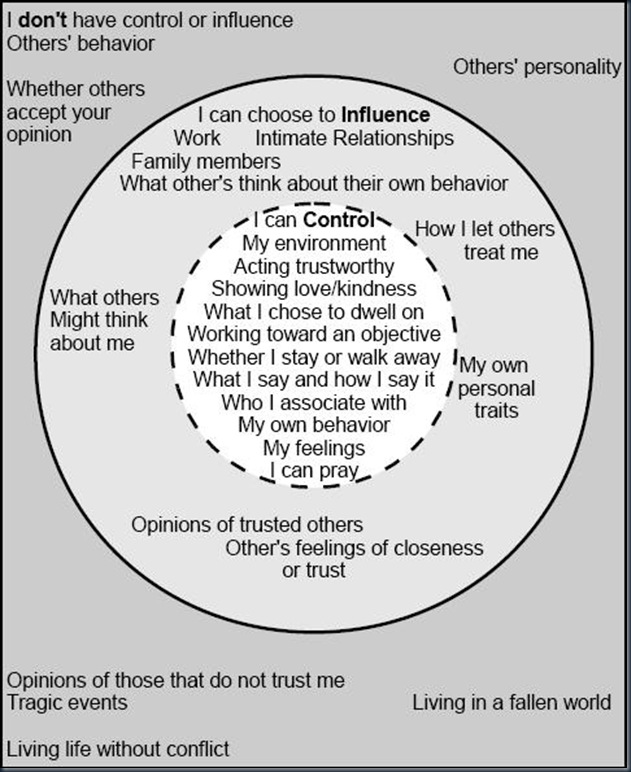
Not accepting something does not change it.  Accepting something gives the possibility of change.   One of the hardest things to accept is that there are some things that are beyond your ability to control.  I have this diagram to help understand what I have control over, what I have influence over, and what I have neither control or influence over.  Trying to control something that you do not have control over is frustrations.  Accepting things you have no control over, accepting that some situations at best you have influence over and focusing your energy on things you have control over is effectiveness.Control influence

Loving

Passionate anger as a force meets it's match with passionate love.  Loving in the midst of anger seems to be foreign to most if not all of us.  I have previously posted on Agape Love here: The Greatest of these is Love, 1 Corinthians 13: What is Love?, Love: Going Deeper in the Word.  Let me say this where love abounds you cannot go wrong.  Where anger abounds you cannot avoid going wrong. 

Mindfulness

I personally advocate Christian mindfulness.  Christian Mindfulness at its core is contemplative awareness by the Spirit (1 Corinthians 2:15).  Contemplation is an act of the will which requires that we be fully engaged in the present moment and dependent on God's Holy Spirit.  Contemplation is where what we know meets what we experience.  It is the process of wisdom.

Beginning with awareness of your signals and triggers you move into greater awareness of the circumstance (awareness of environment or of the moment), Person or people that are involved (awareness of relationships), and prayerfully aware of what God is doing to work through this circumstance (spiritual awareness).   When we are able to enter into the "peace of God" we achieve Christian Mindfulness.  

Mindfulness not only involves greater awareness, but also increased potential to act effectively.  When it comes to anger it will allow you set aside selfish desires and see the most beneficial and effective course of action. More on this here: Awareness of Self (Effectiveness). 

Well I have covered the CALM part of CALM MIND.  I hope that I can get back to the second half soon.  I am not sure as it will be busy the next couple of days and I want to thoughtfully and mindfully describe Meditation, Improve, Nurture, Diversion.  My hope is that these posts are helpful in dealing with anger.  I will be putting up a Table of Contents as soon as I have worked through this series.  Please be in prayer for me as I consider writing a book.  I am sensing that this is the direction to go for me, but I still have reservations (Grammar being one of them).  My hope is to present something that helps me to fulfill the mission:

To live and challenge others to live excellent, fulfilling, and authentic lives.

I hope that is what this blog is doing for you as well.  Thank you for your prayers and readership.  You all are a blessing to me!

~BJ

Enhanced by Zemanta

Tuesday, December 21, 2010

Can God Create and Object So Big He Cannot Move It?

Black Hole in the universe

Image via Wikipedia

This is another supposed contradiction that Atheists like to throw out to challenge the idea of an all powerful (omnipotent) God.   The argument creates a dilemma in that God is either not omnipotent because He cannot create such a thing or He is not omnipotent because He cannot move it.  The problem though is not in the dilemma, but with the question itself.  The question is logically flawed. 

Remember for the Atheist (as I have said before) this is an absurd question.  Why a person would want to know if an imagined being could move and immovable object is confusing to me.  It would seem that putting energy in to such fiction would be a waste of time.  In short I would quickly say that any fantasy being could move any fantasy object without any problem while still creating something that is unmovable at the same time.  This is fantasy after all.

Moving on though to the question at hand.  The goal is to call into question the Omnipotence of God.  In my estimation we cannot in our finite understanding be aware of what omnipotence is.  If we could understand the most powerful force in the universe we would just be scratching the surface of understanding omnipotence.  If it takes 70,000 computer processors to figure out the merging of two black holes, then understanding omnipotence is a bit more processing power than my tiny brain can handle.  At best we can imagine that God is more powerful than the most powerful thing we can think of. 

My concern though is for the second half of the question.  First the size of the object.  For an object to be so big it would have to be larger than the force trying to move it.  Omnipotence by definition is infinitely powerful.  So in this case our object would have to be infinitely large.  Creating an infinitely large object would displace everything else in existence.  It would be the utter obliteration of everything (Including God Himself?).  This would make such an object a fantasy.  It would be an unreal object.  Can God create something that does not have the possibility of existing.  No!  Why?  Because it is a contradiction.  For an object to exist it must be finite and if it is finite then God can move it.  Something finite cannot be infinite.  So such an object cannot logically exist.

Next looking at the properties of Objects.  I would say that moveability  is a universal property of objects.  Throughout the universe we see objects in motion.  There is no corner in which we find something that is not moving in some way, shape, or form.  I propose that it is not possible for an immoveable object to exist.  Everything is in motion in some manner.  Even Black holes (in my limited understanding) are in motion.  So if the most massive objects that we are aware of are in motion then an object even more massive would have to be in motion as well.  What is more motion is measured relative to another object.  So in order to test whether it was not moved there would need to be two of these immoveable objects.  I am having trouble imagining one now we need two.  Hmm!

One more thing, the laws of astrophysics would indicate that as an object got larger it would reach such a size that the gravitational pull of that object would begin to pull itself into itself creating a black hole.  As that object became more massive then it would reach the mass of the universe.  What is larger than the mass of the universe?  I am not sure, but if our universe is moving I am not sure what a black hole more massive than our universe would be?  Singularity perhaps.  Could God move it?  Yes  we exist don't we.   So you see no matter the enormous mass of this supposed object it would have the quality of moveably.  An immoveable object is a contradiction in and of itself.  So it cannot exist. 

In conclusion then the question is illogical.  Illogical questions can be answered however you want, but you will never know nor can you arrive at the correct answer. 

I have a question for the Atheist.  Can any researcher create a computer simulation of an immoveable object?  They might want to start here and get up to speed.  This simulation took 70,000 processors three months to compute.  I wonder how they connected all those laptops :-) .  Here is what they produced. 


Well at least we know the object is bigger than the little guy on the left and also bigger than the guy on the right Notice the little ripple at the end as it takes the little black hole into itself. 

God Bless You

Enhanced by Zemanta

OK I'm Angry So Now What? (Learning Relaxation)

relax time

Image by Xavier Fargas via Flickr

Once a person has recognized their triggers and signals, what does he/she do next?  I have previously posted on the Biology of Anger here.  In short it difficult to overcome biology.  When you are angry your fight or flight response needs to be quieted.  This is primarily accomplished through relaxation (see here for some ideas).

Relaxation and intense anger are incompatible states.  The idea is to become so good at relaxation that you can sort of turn it on.  Some people mistake relaxation to be an event.  For example: "I can't wait for the weekend so I can relax."  or "I will finally be able to relax on vacation."  or "When I lay down I can relax."  The problem with this view is that relaxation is tied to your external circumstances.  Relaxation is not of any particular use if you are angry about your situation.  The situation is not relaxing by definition.  However, relaxation is not an event.  It is a skill and a state of mind. 

I don't say this out of need, for I have learned to be content in whatever circumstances I am.
Philippians 4:11 (HCSB)

Contentment is relaxation of the soul.  If Paul has learned how to be content in whatever circumstances he is in the I firmly believe that we can do the same. 

Start with relaxing the body.  There are many strategies for relaxation.  I have written about a few that I have used with people in my counseling practice.  Here are a few more ideas.  The goal is to find one that works for you and practice it every day. 

By practicing it everyday you accomplish at least three things. 

First you learn to recognize tension.  by recognizing the difference between a relaxed and tense state you can add this to your awareness of signals for anger. 

Second you lower your set level of tension.  We all have a general level of tension in our day to day life.  Some people's level is higher and others lower.  By lowering you set level of tension you give yourself more room to respond over reacting.  Think of it this way if you are already highly tense then it will not take much additional stress from your circumstance to push you into a negative reaction.  But if you are lower in tension from practicing relaxation then it will take more stress to push you to a negative reaction, which will give you more time to effectively respond. 

The third thing that practicing relaxation accomplishes is that you get better at it.  Think of an activity that you get better at with more practice.  The same is true for relaxation.  In fact the better you get at relaxation the more effectively you can use it in a tense moment. 

I have had people tell me in counseling, "I have tried those relaxation strategies and they do not work for me."   When I ask them when the tried it they respond, "When I got angry of course."  There is a problem in this thinking.  If you are a basketball player and the only time you take shots at the basket is during a basketball game you are not going to me a good basketball player.  To be good at something takes practice.  Some activities take a lot of consistent practice.  Relaxation is one of those activities in my opinion. 

Practicing relaxation has many health benefits as well.  Give it a try.  Notice the sense of well-being that comes through effectively relaxing. 

God Bless You

Enhanced by Zemanta

Monday, December 20, 2010

Recognizing Anger

CAPE CANAVERAL, FL - AUGUST 26:  A stop sign i...

Image by Getty Images via @daylife

If you travel through life ignoring the signals or triggers for your anger it is a bit like driving while ignoring stop signs.  Eventually you will get into trouble or in to a serious accident.  There are three types of anger signals:  Body signals, thought signals, and actions signals.  Triggers are the situations that typically result in you feeling angry.

Body signals are the sensations that you feel when you are angry.  These sensations are automatic (see previous post).  Most people will feel hot, some sweaty, nausiated, headache, muscle tension, beathing hard, and so on.  The trick is to be more aware of your personal signals.  If you recognize that you are feeling angry then you can identify your body signals by thinking over the previous several minutes and becoming more aware of how you feel physically.  The tendency is to short change this awareness by simply stating, "I feel angry."  This is usually a thought or at least an emotion.  But awareness involves being more aware of how your body feels over just knowing that you are angry. 

Thought signals are the automatic thinking that occurs when you are angry.  For example:  Someone cuts you off in traffic and you think, "You idiot you are going to get someone killed."  That is an automatic thought.  These automatic thoughts often fit a similar pattern across various settings.  The most common pattern is to label people or situations with deregulatory language.  There can also be emotionally charged words like hate, pissed off, F%$# you, sucks, and so on.  Each person has their own pattern in thinking when they are angry.  The trick is to recognize your own.  Another common pattern of angry thinking is the just/unjust (either-or thinking).  You let some perceived injustice be the justification for your anger.  When in reality it is more likely the other way around.  It  is the perception and not the event itself that is triggering your anger.  For example: What if I told you that the person that cut you off in traffic was taking his child the emergency room because she is very ill.  You would change your thinking, "Be careful I hope that your daughter gets better.  That feeling is compassion over anger.  What changed?  Your thinking.

Action signals are the behaviors that you do when your angry.  Often others will recognize our action signals long before we are aware of them ourselves.  If you are bold you can ask others to help you identify your signals when they observe them.  It might be better to ask them to tell you when you are not angry at the time.  Telling someone their anger signals while they are angry is usually met with defensiveness.  Some typical action signals are: raised voice, complaining, slamming objects, stomping, arguing, clenched fist, clenched jaw, punching, kicking, and so on.  Each person has actions that tend to be typical when they are angry.  The goal is to become aware of some of the early signals before your anger leads to the more aggressive ones.  Another way to catch action signals in the moment is when someone says "Why are you angry?"  Rather than the automatic, "I am not angry."  You can say, "What am I doing that makes you think that?"  Most people that we are close with are perceptive of our moods and will be able to identify our anger long before we are aware of it. 

Triggers are the situations or people that can pretty reliable result in our anger.  Being aware of our triggers is beneficial in two ways.  We can learn to avoid unnecessary situations.  Avoiding an angry situation is wise.  Anger in the raw rarely solves anything.  If avoidance is not possible then awareness of our triggers allows us to be prepared to take positive action.  You can plan ahead what you are going to do if that trigger happens.  Planning ahead for angry situations or dealing with people that push our buttons is effectiveness.  Not planning is foolish because you will likely fall into habitual behaviors that have not been effective in the past. 

Being aware of signals and triggers is the first step in coping with or resolving your anger.  If you miss this step you are much less likely to be successful in dealing with anger.  If you do this step then you will be much more prepared to respond rather than react when anger comes your way.

God Bless You

Enhanced by Zemanta

Saturday, December 18, 2010

Euthyphro Dilemma

"Is what is morally good commanded by God because it is morally good, or is it morally good because it is commanded by God?"

This is often presented as a puzzle by atheist because it becomes a circular argument or leads to conclusions that seem to contradict our concept of God.  In the grand scheme of things the whole dilemma is more complicated that it is simply stated. 

First recall the dilemma is absurd to the atheist. 

Is what I think is good (or what we generally call good) commanded by a non-existent being because we think it is good, or is it our thinking it is good because it is commanded by a non-existent being.

After a while one begins to wonder why atheist are so concerned dare I say threatened by absurdities?  It also makes me wonder why some atheists are so vehement against theists.  My advice to atheists, "Screaming and mocking the naive does not make them less naive, but it does make them less likely to listen to you."

As with most of these arguments the defining of words is important.  in this case the defining of a word is the central part of the dilemma.  In short this dilemma could be restated:

Does goodness define itself or does God define goodness. 

The other option is that neither goodness nor God exists.  Which is the way that most hard core atheists go. 

What is meant by "it."

Is what is morally good commanded by God because it is morally good, or is it morally good because it is commanded by God?

"It" seems to be "What is morally good."  If this is the case then the dilemma restated becomes:

Is what is morally good commanded by God because what is morally good is morally good, or is what is morally good, morally good because what is morally good is commanded by God?

This is the core of the defining good.  That is does good define good or does God define good

x commanded by y because x is x or x is x because x is commanded by y

"It" could also be the "what is commanded by God."  If that is the case then the dilemma restated becomes:

Is what is morally good commanded by God because what is commanded by God is morally good, or is what is commanded by God morally good because what is commanded by God is commanded by God?

In this case the first horn is a tautology and the second horn is illogical.

x is y because y is x or x is y because y is y

Either the dilemma is illogical or hinges on defining morally good. 

On the other hand "it" could be generic "the thing" implied by the argument which is the object of our speculation. 

Is what is morally good commanded by God because the thing is morally good, or is the thing morally good because the thing is commanded by God?

If this is the case then we need to define what the thing is before we can proceed to answer the dilemma. 

God commands moral good.  This is a true statement to the theist.  The problem occurs when you attempt to separate moral goodness from God.  Treating moral goodness as a quality independent of the nature of God creates a contradiction in the first horn of the dilemma.  If moral goodness is separate then it constrains God which then God looses his will, sovereignty,  and omnipotence.  However these problems dissolve when you consider that "the thing" to be the nature of God.  Restating the first part of the dilemma becomes:

What is morally good is commanded by God because God's nature is morally good.

If this is what is meant by moral goodness then the first horn of the dilemma is true.  It also answers the question of how to define goodness.  It is God's nature that defines moral goodness.

The second half of the dilemma becomes:

God's nature is morally good because God's nature is commanded by (proceeds from) God

A command is a statement proceeding from the speaker asserting his/her authority.  In this case God's nature then proceeds from God as a word (command).  In short God's nature both defines and acts according to what is morally good.  Interestingly this makes me think of two parts of the Bible that express this idea of goodness proceeding from God in the form of a command.

Then God said, "Let there be light," and there was light. God saw that the light was good, and God separated the light from the darkness.
Genesis 1:3-4 (HCSB)

In the beginning was the Word, and the Word was with God, and the Word was God. He was with God in the beginning. All things were created through Him, and apart from Him not one thing was created that has been created. Life was in Him, and that life was the light of men. That light shines in the darkness, yet the darkness did not overcome it.
John 1:1-5 (HCSB)

In Genesis we discover that God commands into existence many things (in fact all things).  He also observes that it is good.  What makes this interesting is that His creation proceeding forth (by way of command) from His Nature (goodness) becomes an object which He can now describe as "good."  He is the definition, the creator, and the observer of goodness. 

One might object that this goodness is arbitrary and therefore meaningless.  That is to say an all-powerful evil god could do the same thing and call it good.   However God's goodness is immutable.  That is to say unchanging and fixed.  That which is evil and good cannot be arbitrary.  Goodness is fixed in God's nature.  Everything that is good in existence is then a reflection of God's goodness and/or proceeding forth from God.

Every generous act and every perfect gift is from above, coming down from the Father of lights; with Him there is no variation or shadow cast by turning.
James 1:17 (HCSB)

The passage of John identifies the command of God (Word, Logos in Greek) as the person Jesus Christ.  It continues to describe how The Word was God and created all things.  Continuing the Bible says that the Word has "life in Him."  The "life was the light of men."  The light is not darkness.  It shines into the darkness. Spiritual darkness is the absence of spiritual light.  Evil is often equated with spiritual darkness.  Evil then is not so much a quality that is opposite the quality of good as it is the quality of being without God.  This is fundamental to our understanding of Good and evil.  Which I will have a chance to elaborate in future posts I am sure. 

Back to the second half of the dilemma we see a hint of why God created.  God commanded because goodness proceeded from His nature.  It also makes the second half a true statement.  If both halves of a proposed dilemma are true then it is by definition a false dilemma. 

By this point most have lost interest in the dilemma I am sure.  For those of you that read through my philosophical ramblings; Why?  ;-) and thank you for your readership.   In short the dilemma is best answered with a question, "What do you mean by morally good?" And then proceed from that point with the theist position that moral goodness is defined by God's nature, if the atheist is uncommitted.  The rational position for the atheist is that moral goodness does not exist and that goodness is an arbitrary or beneficial opinion of the individual or community that holds it.  The implication of this view is that all manner of evil can be justified because it is a matter of lack of benefit or opinion that it is evil.  But more on that later.

God Bless You

Enhanced by Zemanta

Friday, December 17, 2010

Argument that Goodness and Omnipotence are Incompatible

Atheist

Image via Wikipedia

Another argument that atheist put forth is one of so-called self-contradictory qualities that are attributed to God.  The most common is the the qualities of Goodness and Omnipotence (all-powerful).  The argument goes something like:

1) If God exists then He is all-good
2) If God exists then He is all-powerful
3) A good being corrects evil if it is in their power to do so
4) Evil exists and has always existed in the world
5) God has not acted (from 4)
6) If God unable to prevent evil He is not all-powerful
7) If God does not prevent evil, He is not good
8) Therefore an all-good, all-powerful God does not exist (From 5-7)

Remember this is an absurd argument from an atheist's perspective.  It is absurd in that they are assuming a priori something that they don't believe.  "If a non-existent thing exists."  So the first and second premise falls apart in the atheist's logic.  Arguing from absurdity makes any conclusion suspect. 

A second problem is what is good.  Goodness for the theist is a quality of God that extends to His creation (albeit imperfectly).  That is there is a standard for objective morality (goodness) that is given by God.  By what standard does the atheist use to determine what is good.  At best goodness is an opinion of the person making the judgment.  The first statement becomes "if God exists then he must be good according to my opinion."  The third statement becomes "a being ought to take what I think is good and correct what I think is evil."  The seventh statement becomes "If God does not prevent what I think is evil then He is not good in my opinion."

A third problem is in the assumption that God is impotent to do anything about the evil that exists making Him not all-powerful.  "If He can do something about the evil then why wouldn't He."  That a good being does not act in the face of evil does not automatically mean they are not good nor that they are powerless.  It could be that the being has another purpose, intent, or reason for evil to exist.  It could be that evil exists that goodness might be understood and appreciated.  It might be that evil exists that the good that comes from freedom can be fully realized.  It might be that evil exists because the fullness of time and ultimate goodness has not yet arrived.  There are many more missing bits of information that would lead a good being to not act or to delay their action. 

A forth problem is that it puts the arguer in the position of judge.  In one sense the arguer attempts to place themselves above God.  They are judging what is good, what should be corrected, and that God has not acted.  Let's assume that this person was justified to go where angels fear to tread. Then the arguer must be all-knowing themselves to make the determination that God is not good or that He has not acted.  But in fact they are making an argument from an incomplete understanding of the facts.  God may have acted imperceptible (or not in a manner our arguer expects), God may act in a time yet to come, maybe what we have judged bad may actually turn out good and so on.  The arguer cannot know all things so to make this argument without all the facts is giving one's opinion. 

Fifth, not really a problem more of an observation.  Often someone making this form of argument will have a deeply personal (often painful) circumstance, situation, relationship, and/or event that heavily influences their conclusion.  I believe that Christians would do well to not dismiss "the feeling that..." until they have "fully understood the underlying reason that..."  Even theist struggle with doubt about God's dealings with humanity in general and in our own lives specifically.  Shrill dismissals will not win a person over, but a compassion and an understanding heart just might.  Even great men of God have their moments of doubt.  Humble expressions of doubt will not make you seem weak, but rather it will make you honest. 

Lord, why do You stand so far away? Why do You hide in times of trouble?
Psalms 10:1 (HCSB)

I will say to God, my rock, "Why have You forgotten me? Why must I go about in sorrow because of the enemy's oppression?" My adversaries taunt me, as if crushing my bones, while all day long they say to me, "Where is your God?"
Psalms 42:9-10 (HCSB)

In conclusion then we have an atheist who makes an argument which essentially says, "In my opinion God does not exist."  For an atheist to state their opinion in logical form is not a very powerful argument.  On the other hand we also need to recognize that we can minister to a hurting person if they let us.  Let us be mindful that we might not add to another's pain, but could possibly bring them from spiritual darkness into The Light.

God Bless You

Enhanced by Zemanta