Here is my sermon from 5/1/11: Completed Joy

Showing posts with label Awareness. Show all posts
Showing posts with label Awareness. Show all posts
Monday, May 2, 2011


Wednesday, December 22, 2010
Calming the Mind (CALM)

Image via Wikipedia
Equally if not more important to calming the body in the heat of anger would be calming the mind. It is the mind that invents all manner of evils (and goods) to hoist upon those that we are most passionate about (good or bad). Without calmness of the mind one risks acting out rashly, harshly, with vengeance even when it is done with premeditation. This is not a direction we want to go. Thoughtful? Yes! Intentional? Yes! Hurtful? No! Destructive? Definitely not! When cooler heads prevail you will nearly always regret the latter two, but you can nearly always celebrate the first two.
How do we move to be more calm of mind? I think there are several concepts that need to be explored in having a "CALM MIND": Contentment, Acceptance, Loving, Mindfulness, Meditation, Improve, Nurture, Diversion.
Contentment
I know both how to have a little, and I know how to have a lot. In any and all circumstances I have learned the secret of being content whether well fed or hungry, whether in abundance or in need.
Philippians 4:12 (HCSB)
This is quite a statement. First, I tells me that contentment is a learned way of being. If you learn something know how to do it not the same as doing it nor doing it well. These things take intentional practice to do them well. Contentment falls into that category. Contentment is the quietness of soul that comes over a person when all is well. Yet Paul is writing the Philippians here that he has learned contentment in "any and all circumstances." So the second thing I learn is that true contentment is not tied to external circumstances. He takes it further and says, "whether well fed or hungry." True contentment is not tied to getting some need met. This is quite extraordinary. If you ask someone what is contentment they will always point to some peaceful external circumstance or getting some need satisfied. Yet Paul is saying plainly that there a contentment that is greater than these. How does he do that? Four things that he does: he trusts in his relationship with Christ (Philippians 4:13); he prays (Philippians 4:6-7); he is thankful (Philippians 4:4, 10); and he meditates on the good things in life (Philippians 4:8). Now each of these may be difficult to do in the moment that you are angry, but remember this is a discipline that you want to learn well. More on Contentment here: Christian Mindfulness (Contentment)
Acceptance
Acceptance is the act of receiving something. Often we do not like things or we believe they are unjust or unfair or are not what we want. Accepting something you do not want is like drinking vinegar. Non-acceptance is the rejection of something. Now if that something is a circumstance then acceptance means that you receive the circumstance as it is. Not that you judge it to be good, but that you acknowledge it is what it is. You stop fighting against reality and come into contact with it as it is. If the something is a person, then you accept them as they are, the good and the bad. Not that you desire that they stay that way or that the nature of your relationship has to stay the same, but you accept them as a human being with shortcomings even as you are a human being with shortcomings.
As a Christian my acceptance is rooted in my acceptance of Jesus Christ as the Lord (in charge of) and Savior (rescuing me from my shortcomings) of my life. My acceptance of my circumstances and of others is rooted in this truth. That God accepts me through the relationship that I have with His Son Jesus Christ. God's acceptance of me and my acceptance of Him becomes the foundation of my acceptance of people and events in my life. I also note the the reverse is true. There are times when my acceptance of God is diminished. At those time my acceptance of circumstances and people also diminishes.
I often share this analogy when it comes to acceptance:
Imagine that you go home and your bedroom has been painted your least favorite color. You are shocked and disgusted by the color so you close your eyes and pretend like it is not painted that color. Your quickly find your way to the door and refuse to reenter the room until it is dark. Not turning on the lights you get ready for bed and go to bed. The next morning you wake up and open your eyes to discover much to your dismay that the room is still that ugly color. You again close your eyes and find your way to the door and leave. You again refuse to go into the room until it is dark to avoid seeing that ghastly color. You do this a second night, a third night, a week, two weeks, a month, two months. Let me ask you, "What color is the room?" For all that effort and energy over the last couple of months the room color has not changed and you are most likely more miserable than when you started. This is non-acceptance. It is only through acceptance that you can actually do something about the color of the room.
Not accepting something does not change it. Accepting something gives the possibility of change. One of the hardest things to accept is that there are some things that are beyond your ability to control. I have this diagram to help understand what I have control over, what I have influence over, and what I have neither control or influence over. Trying to control something that you do not have control over is frustrations. Accepting things you have no control over, accepting that some situations at best you have influence over and focusing your energy on things you have control over is effectiveness.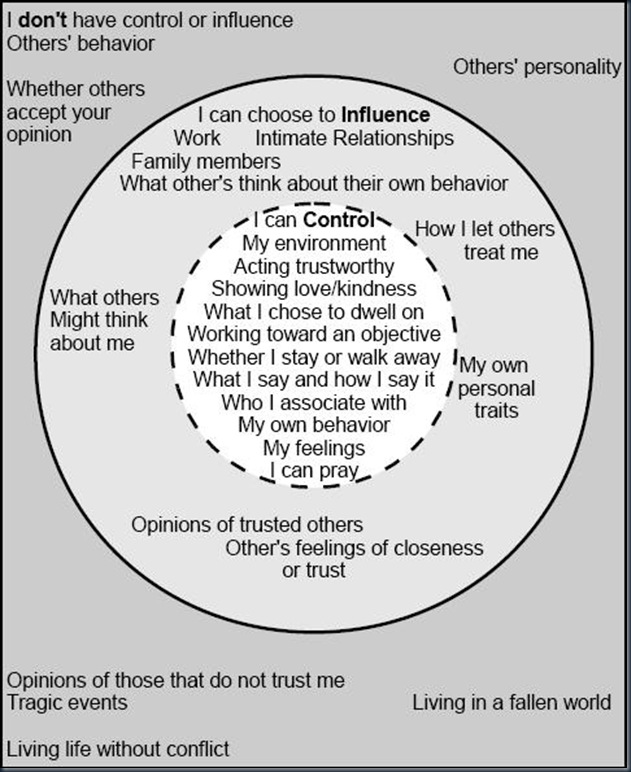
Loving
Passionate anger as a force meets it's match with passionate love. Loving in the midst of anger seems to be foreign to most if not all of us. I have previously posted on Agape Love here: The Greatest of these is Love, 1 Corinthians 13: What is Love?, Love: Going Deeper in the Word. Let me say this where love abounds you cannot go wrong. Where anger abounds you cannot avoid going wrong.
Mindfulness
I personally advocate Christian mindfulness. Christian Mindfulness at its core is contemplative awareness by the Spirit (1 Corinthians 2:15). Contemplation is an act of the will which requires that we be fully engaged in the present moment and dependent on God's Holy Spirit. Contemplation is where what we know meets what we experience. It is the process of wisdom.
Beginning with awareness of your signals and triggers you move into greater awareness of the circumstance (awareness of environment or of the moment), Person or people that are involved (awareness of relationships), and prayerfully aware of what God is doing to work through this circumstance (spiritual awareness). When we are able to enter into the "peace of God" we achieve Christian Mindfulness.
Mindfulness not only involves greater awareness, but also increased potential to act effectively. When it comes to anger it will allow you set aside selfish desires and see the most beneficial and effective course of action. More on this here: Awareness of Self (Effectiveness).
Well I have covered the CALM part of CALM MIND. I hope that I can get back to the second half soon. I am not sure as it will be busy the next couple of days and I want to thoughtfully and mindfully describe Meditation, Improve, Nurture, Diversion. My hope is that these posts are helpful in dealing with anger. I will be putting up a Table of Contents as soon as I have worked through this series. Please be in prayer for me as I consider writing a book. I am sensing that this is the direction to go for me, but I still have reservations (Grammar being one of them). My hope is to present something that helps me to fulfill the mission:
To live and challenge others to live excellent, fulfilling, and authentic lives.
I hope that is what this blog is doing for you as well. Thank you for your prayers and readership. You all are a blessing to me!
~BJ

Monday, December 20, 2010
Recognizing Anger

Image by Getty Images via @daylife
If you travel through life ignoring the signals or triggers for your anger it is a bit like driving while ignoring stop signs. Eventually you will get into trouble or in to a serious accident. There are three types of anger signals: Body signals, thought signals, and actions signals. Triggers are the situations that typically result in you feeling angry.
Body signals are the sensations that you feel when you are angry. These sensations are automatic (see previous post). Most people will feel hot, some sweaty, nausiated, headache, muscle tension, beathing hard, and so on. The trick is to be more aware of your personal signals. If you recognize that you are feeling angry then you can identify your body signals by thinking over the previous several minutes and becoming more aware of how you feel physically. The tendency is to short change this awareness by simply stating, "I feel angry." This is usually a thought or at least an emotion. But awareness involves being more aware of how your body feels over just knowing that you are angry.
Thought signals are the automatic thinking that occurs when you are angry. For example: Someone cuts you off in traffic and you think, "You idiot you are going to get someone killed." That is an automatic thought. These automatic thoughts often fit a similar pattern across various settings. The most common pattern is to label people or situations with deregulatory language. There can also be emotionally charged words like hate, pissed off, F%$# you, sucks, and so on. Each person has their own pattern in thinking when they are angry. The trick is to recognize your own. Another common pattern of angry thinking is the just/unjust (either-or thinking). You let some perceived injustice be the justification for your anger. When in reality it is more likely the other way around. It is the perception and not the event itself that is triggering your anger. For example: What if I told you that the person that cut you off in traffic was taking his child the emergency room because she is very ill. You would change your thinking, "Be careful I hope that your daughter gets better. That feeling is compassion over anger. What changed? Your thinking.
Action signals are the behaviors that you do when your angry. Often others will recognize our action signals long before we are aware of them ourselves. If you are bold you can ask others to help you identify your signals when they observe them. It might be better to ask them to tell you when you are not angry at the time. Telling someone their anger signals while they are angry is usually met with defensiveness. Some typical action signals are: raised voice, complaining, slamming objects, stomping, arguing, clenched fist, clenched jaw, punching, kicking, and so on. Each person has actions that tend to be typical when they are angry. The goal is to become aware of some of the early signals before your anger leads to the more aggressive ones. Another way to catch action signals in the moment is when someone says "Why are you angry?" Rather than the automatic, "I am not angry." You can say, "What am I doing that makes you think that?" Most people that we are close with are perceptive of our moods and will be able to identify our anger long before we are aware of it.
Triggers are the situations or people that can pretty reliable result in our anger. Being aware of our triggers is beneficial in two ways. We can learn to avoid unnecessary situations. Avoiding an angry situation is wise. Anger in the raw rarely solves anything. If avoidance is not possible then awareness of our triggers allows us to be prepared to take positive action. You can plan ahead what you are going to do if that trigger happens. Planning ahead for angry situations or dealing with people that push our buttons is effectiveness. Not planning is foolish because you will likely fall into habitual behaviors that have not been effective in the past.
Being aware of signals and triggers is the first step in coping with or resolving your anger. If you miss this step you are much less likely to be successful in dealing with anger. If you do this step then you will be much more prepared to respond rather than react when anger comes your way.
God Bless You

Tuesday, December 14, 2010
Path to Peace

Returning back to my posts on anger, I previously posted on the ring of anger. The ring of anger keeps anger going without resolution. Just avoiding the things that are unproductive and unhealthy with anger does not resolve the feeling of anger. I would even go further and say that unless you do something with the anger you are likely "stuffing it."
The path of peace is a better way to handle the feelings of anger. Remember it is not anger that is good or bad it is the way you handle it that makes it good or bad. The four ways that are the path to peace are Show it positive (express it), Shape it, Sort it out, and/or Surrender it.
Show It Positive (Express It)
Since you put away lying, Speak the truth, each one to his neighbor, because we are members of one another. Be angry and do not sin. Don't let the sun go down on your anger, and don't give the Devil an opportunity.
Ephesians 4:25-27 (HCSB)
One of the signs of emotional maturity is the ability to express feelings in a healthy manner. Expressing anger in a mature, clear, and healthy way is very difficult. Part of the reason is that when you are angry the thinking/planning/organizing/rationalizing part of your brain is slowed way down. The other part of your brain is sending the signal "punch this guy" or "run away." The rational part of your brain is lucky to guide that into a verbal response which usually results in a verbal attack or quiet seething. While the verbal response is desirable to a physical attack it is lacking in emotional maturity.
Expressing emotions like anger in a mature manner involves several steps. First you have to be aware that you are angry. That might seem funny to you, but most people that struggle with anger are not aware of their anger until after they have said or done something that they regret or hurt another person. You may have said or been told in a loud angry tone, "I AM NOT ANGRY!" It is the contradiction that demonstrates a lack of awareness. The second step is understanding why you are angry. "What is the trigger?" "What do I believe about the situation?" "Do I understand why I am feeling this way?" After you are aware of and understand your anger, then it is time to put it into words. The typical suggestion is "When" (Fill in the trigger) "happens I feel angry." There are many words that describe the feeling of anger that can be applied to different types of anger as well as different intensities of anger. Find the right word. It might be helpful to learn a vocabulary of anger (more in a future post).
Shape It
A ruler can be persuaded through patience, and a gentle tongue can break a bone.
Proverbs 25:15 (HCSB)
In 1980 13-year-old Cari Lightner was killed by a drunk driver. Candy Lightner was devastated by the loss, as any parent would be. She learned that the man that had killed her daughter would not spend much (if any) time in jail. She felt enraged and helpless. Candy her mother promised herself that she would not let her daughter's death be meaningless. Later that same year Candy formed Mother's Against Drunk Drivers (MADD) on September 5, 1980 (Cari's Birthday).
Anger is a powerful force. Undirected it is destructive to the victim and the perpetrator. But if that force can be channeled it becomes an unstoppable movement for positive change. How does one woman's anger become an international movement? It is in the quality of shaping your anger to a positive outcome. Now you may not start a national movement (or maybe you might), but you can use that same force to accomplish some good in your life and the life of others. It takes support from friends and family. A willingness to let go of the destructive side of anger, and an unwavering commitment to see that anger motivate you to greater action. It will take greater effort and thoughtfulness, but the wonderful thing about anger is how incredibly motivating it is. Use that motivation or energy to do something positive. It could be as simple as using it for an intense physical workout at the gym or as dramatic as starting a movement that radically changes your world. Whatever it is channel it into something good!
Sort It Out
But I tell you, everyone who is angry with his brother will be subject to judgment. And whoever says to his brother, 'Fool!' will be subject to the Sanhedrin. But whoever says, 'You moron!' will be subject to hellfire. So if you are offering your gift on the altar, and there you remember that your brother has something against you, leave your gift there in front of the altar. First go and be reconciled with your brother, and then come and offer your gift. Reach a settlement quickly with your adversary while you're on the way with him, or your adversary will hand you over to the judge, the judge to the officer, and you will be thrown into prison.
Matthew 5:22-25 (HCSB)
Once a person has understood there anger it is beneficial to do something to sort it out. Sorting it out will often involve going to the person that you have offended or who has offended you. If you desire to sort it it out you have to approach the situation with a sincere desire to make things right. It will not work if you go with the intent of justifying hurtful, harsh, or demanding manner then it will not likely work. But if you go with grace, leniency, and a desire for reconciliation then you can have hope of sorting it out. The process of sorting things out can be very complicated and difficult. It can also be very time consuming. Often it is not immediate so patience is a must. What is more is sorting things out with another assumes that the other person is in a place to want to do the same. Demanding that a person who is not ready to sort things out with you cooperate with your effort and "good will" is a sure recipe for frustration and increased anger. This will further strain the relationship. Just remember this:
Do not repay anyone evil for evil. Try to do what is honorable in everyone's eyes. If possible, on your part, live at peace with everyone.
Romans 12:17-18 (HCSB)
If it is not possible or if it is not practical to sort it out with another person sometimes you can sort out your anger by your self or with a trusted person than can listen to you and give honest feedback. The goal of sorting it out on your own is to take your understanding and awareness to a deeper level. Greater understanding will help you then to identify the things that you can change in yourself or in your environment to avoid triggers or resolve the anger that you experience. Sorting it out will often lead to some level of acceptance for the way things are. Not that you have to judge the situation as just, fair, or good, but that you accept it. Once you are able to accept it then you can move to the next stage on the path to peace.
Surrender It
I view surrendering anger from a spiritual view point. It is hard for me to imagine surrendering anger from any other perspective. I see surrender as different than forgetfulness or not bringing it back up. Forgetfulness (if such a thing is possible) is unmindful. It is a type of self-denial. You have to forget being hurt and constantly work a releasing the hurt over and over and over again. This may not be so hard for minor offences, but when someone has deeply hurt you this constant state of trying to release the hurt is in itself hurtful. You have to deny you hurt, but how do you deny what you feel. You have to deny yourself. Self-transcendence is an extremely difficult road to take. Few (if any) ever arrive. When you fail at this self-denial then you are likely to beat up your self or have others beat you up emotionally by saying, "Why can you just get over it." Not bringing it back up is also a type of self-denial. Forgetfulness denies how you feel. Not bringing it back up denies what you think. You are reminded of the thing that made you angry and think on it, but do not express it. You try to push it away from your awareness. What I think happens is that the thought that is put away in an effort to not bring it up lies in our sub-conscious waiting until some other event reawakens our awareness of the thought. Often this repeated awakening of the angry thought intensifies every time and eventually leads to resentment and/or forceful expression of the angry thought in some future discussion.
So what then if denying how you think or feel does not lead to resolution then how does one take this path to peace? Surrender is the key.
| sur-ren-der: | to yield (something) to the possession or power of another |
| to give oneself up, as into the power of another; submit or yield |
I use surrender in both senses of giving an object up as well as giving one's self up. The object that you surrender is anger. You yield or turn over the anger to the power of another. To whom or what do you surrender the anger to? Well I am convinced that spiritually speaking no one can receive someone else's anger by way of surrender. It can only be received by another person through force, retaliation, or retribution. I believe that only God can receive our anger by way of surrender. Consider that surrendering anger to God is being obedient.
Friends, do not avenge yourselves; instead, leave room for His wrath. For it is written: Vengeance belongs to Me; I will repay, says the Lord.
Romans 12:19 (HCSB)
What is more surrendering your anger to God is a statement that you trust Him to work it out for the best. When I try to avenge my anger I am just as likely to be angry in an unjustified or extreme way. God on the other hand will execute justice in perfection. What is more if the person is repentant it gives you a path toward restored relationship. If you do not surrender your anger then even if the other person comes to you and says, "I am sorry" you will not have freedom to reconcile until you surrender your anger.
Surrendering involves self-surrender. First you submit to God.
But He gives greater grace. Therefore He says: God resists the proud, but gives grace to the humble. Therefore, submit to God. But resist the Devil, and he will flee from you.
James 4:6-7 (HCSB)
Then you submit to others.
Do nothing out of rivalry or conceit, but in humility consider others as more important than yourselves. Everyone should look out not only for his own interests, but also for the interests of others.
Philippians 2:3-4 (HCSB)
Even submit to those that are against you.
But I tell you, don't resist an evildoer. On the contrary, if anyone slaps you on your right cheek, turn the other to him also. As for the one who wants to sue you and take away your shirt, let him have your coat as well. And if anyone forces you to go one mile, go with him two.
Matthew 5:39-41 (HCSB)
You have heard that it was said, Love your neighbor and hate your enemy. But I tell you, love your enemies and pray for those who persecute you, so that you may be sons of your Father in heaven. For He causes His sun to rise on the evil and the good, and sends rain on the righteous and the unrighteous.
Matthew 5:43-45 (HCSB)
But this is too hard you say. I agree. I think apart from a relationship with God through Christ this type of submission is impossible. It requires that you have honor toward Christ, relating to God, and filled by the Spirit.
... but be filled by the Spirit... submitting to one another in the fear of Christ.
Ephesians 5:18 and 21 (HCSB)
The scope of submitting is far beyond what can be summed up in this brief post. What I have done is given you a path. A Path to Peace. Now whether you choose to walk this path is up to you. I pray that you find it and that the Spirit of God so fill you that you arrive safely in God's peace.
God Bless You

Monday, July 26, 2010
Cain Became Furious
In the course of time Cain presented some of the land’s produce as an offering to the Lord. And Abel also presented an offering -some of the firstborn of his flock and their fat portions. The Lord had regard for Abel and his offering, but He did not have regard for Cain and his offering. Cain was furious, and he looked despondent. Then the Lord said to Cain, "Why are you furious? And why do you look despondent? If you do what is right, won’t you be accepted? But if you do not do what is right, sin is crouching at the door. Its desire is for you, but you must rule over it." Cain said to his brother Abel, "Let’s go out to the field." And while they were in the field, Cain attacked his brother Abel and killed him.
Genesis 4:3-8 (HCSB)
The first violent sin was the result of unresolved anger. Perhaps that is why Jesus said:
You have heard that it was said to our ancestors, Do not murder, and whoever murders will be subject to judgment. But I tell you, everyone who is angry with his brother will be subject to judgment. And whoever says to his brother, "Fool!" will be subject to the Sanhedrin. But whoever says, "You moron!" will be subject to hellfire.
Matthew 5:21-22 (HCSB)
or why John said:
Everyone who hates his brother is a murderer, and you know that no murderer has eternal life residing in him.
1 John 3:15 (HCSB)
That unresolved anger can lead to violence whether verbal, emotional, psychological, or physical there can be no question. That is why this is such an important issue to address.
There are two way to interpret what God says to Cain. Traditionally God gives us a admonition. He warns that unresolved feelings of anger and feeling down give sin a foothold in your life. I imagine a predatory animal just waiting to pounce. It seems that sin is a opportunist taking advantage of our emotional state to do it's dirty work. In this case the goal is to do what is right, rule over sin, or it will rule over you.
The second way is looking that the interpretation from Hebrew to English more literally. The word interpreted sin in this verse is "chatta-ah" in Hebrew. This word can either be interpreted sin or sin offering. If we go toward the latter then it would seem that God was giving Cain instruction on what to do with his sin. Consider this translation:
And Jehovah saith unto Cain, "Why hast thou displeasure? and why hath thy countenance fallen? Is there not, if thou dost well, acceptance? and if thou dost not well, at the opening a sin-offering is crouching, and unto thee its desire, and thou rulest over it."
Genesis 4:6-7 (YLT)
In this case he says if you have done well then there is acceptance. We know that God did not accept his sacrifice so then God goes on to say there is a sin offering at the opening (door) waiting for him to rule over it. If this is the interpretation then I believe the whole interaction makes sense. Cain offers a first fruits or grain offering offering to the Lord from the produce of the ground (See Lev 2:14). Abel did this as well, however he (either in place of or in addition to) brings an animal sacrifice. It is clear later in the Old Testament and then fulfilled in the New Testament that there is no remission of sin without a sin offering.
For the bodies of those animals whose blood is brought into the most holy place by the high priest as a sin offering are burned outside the camp. Therefore Jesus also suffered outside the gate, so that He might sanctify the people by His own blood.
Hebrews 13:11-12 (HCSB)
So Abel's offering was not accepted because it was substantively better but rather it was a more complete (excellent) sacrifice offered in faith that God would remove sin (i.e., be approved as righteous before God; see Heb 11:4). What is more if we follow this interpretation God provided Cain a second chance by putting a sin offering (at the door) which Cain subsequently rejected and went out and murdered his brother. How often do we do the same when it comes to being angry. We do not go out a literally kill someone, but we do reject the grace that God provides us and move into the greater consequences of greater sin brought about by passionate anger.
Regardless of which interpretation you would follow there is action that is needed when it comes to dealing with anger. Perhaps in this case we could take it to have double meaning (which does occasionally happen in the Bible) since they do not contradict each other. First we must guard against sinful anger by doing what is right in the first place with a spirit of sacrifice (Rom 12:1-2). Second, if we are angry we must be on guard to not sin (Eph 4:26). If we do not guard ourselves then we will likely fall into sinful response in our anger. Finally, if we do sin there is a provision of God's grace waiting at the door (Rev 3:19-20). We must receive this provision of grace and allow Christ to overcome our anger at the moment it comes to us.
Three principles:
- Protective: Do what is right.
- Awareness: Be on guard against sinful anger
- Restorative: Repent of anger and trust in God's grace through Jesus
May God Richly Bless You
Wednesday, July 21, 2010
What is Beautiful?
Having two beautiful daughters gets a dad thinking about how culture defines beauty. As Christians we ought to be counter-cultural on this issue. Beauty as the world defines it is vain and destructive to the souls of women (and men). When society says you have to be something that you cannot be it is an unfair and unjust proposition filled with disappointment if you stand by and support it. Here is a video that made me think about this issue.
The band is Everlife and the video was produced by Ransomtv a part of the Billy Gramm Evangelistic Association.
Tell the girls in your life they are beautiful.
Have a blessed day!
Wednesday, June 30, 2010
Anger
He (God) did not have regard for Cain and his offering. Cain was furious, and he looked despondent. Then the Lord said to Cain, "Why are you furious? And why do you look despondent? If you do what is right, won't you be accepted? But if you do not do what is right, sin is crouching at the door. Its desire is for you, but you must rule over it." Cain said to his brother Abel, "Let's go out to the field." And while they were in the field, Cain attacked his brother Abel and killed him.
Genesis 4:5-8 (HCSB)
And so anger has plagued the human race ever since. It happened to me just the other night. I came home from work and went to put the dog's in and saw that the pool cover was at the bottom of the pool. So I fished the cover out getting wet in the process. I noted that burn beginning to build. I fought through it. I then attempted to put the cover on as I moved around the pool I felt the fence snag the back of my shirt. I could not see it but I was sure that my shirt was ruined. Then I stepped into a puddle of water and my foot sank in soaking my sock. Ugh!!! As if that was not enough the liner began to sink. "This will never do!" I muttered to myself. I thought, "Why did they not tie the cover to keep it secure." Having no idea who "they" was. For all I knew it could have been any of the kids. It is a minor feat for me to get the cover on for them it would have taken a lot. I did not think of that at the time. It was their fault and I was angry. I walked in to the house very upset at this point and called up the stairs (yelled my wife later informed me), "I need someone to come help me with pool cover." I did not use any hurtful words, but my wife said my tone of voice was bad enough. My son helped me get the pool cover on. All was well or so I thought. You see my anger had already set fire to the evening. Too late it was ablaze. Within the first five minutes I created an evening of discontent and discomfort. Anger is such a wonderful thing. Not! Well we recovered, but God has not let that go until I write about it here.
I feel like I have just been to confession 
Anger is a fire according to the Bible. The first murder recorded in Genesis 4. "Cain was Furious." The Hebrew word charah means to burn or kindle. Cain was angry and that anger was burning. God saw that anger and warned Cain that "Sin was crouching at the door." God also said that Cain, "must rule over it." It seems to me anger is one of those passions that must be ruled over or it will rule over you. I hope that you have better reaction than I did.
Father God, Teach us to rule over the passion of our emotions. You created us to have these passions. In and of themselves they must be good. You do not create anything evil. Sin has marred our passions as it has the rest of creation. Teach us how we might be angry and not sin. Teach us to rule over that sin crouching at the door. Quiet our souls when anger rules the day. Lead us into paths of peacemaking that we might be blessed. In Jesus Name AMEN
Monday, May 17, 2010
Meditation: Longing to Be Clothed in Life
Passage
1 Corinthians 5:2-3
Context
Paul is providing his insight as to way he does not fear death and suffering.
Key Words
Groaning, Desiring, Dwelling, Heaven
Message
What can I say. Oh to be home with the Lord. It seems that this type of thinking could lead to greater suffering if the though leads us to reject what is our present circumstance. However it can be a great source of comfort if we recognize that this groaning produces an eternal good. Not long from now (from eternities perspective) we will be home. Mortality will be swallowed up in life (1 Corinthians 5:4). Now in this life God has given us this moment to live. And live it we must. To its fullest potential even as we groan naked longing to be clothed in eternities garb. One thing we do have. The Holy Spirit of God given as a promise and a taste of eternities light (1 Corinthians 5:5). So I long for the next and aim to please in this my moment given by God to accomplish his purpose in this world.
Bless You
Saturday, January 30, 2010
In the Midst of Dark Times
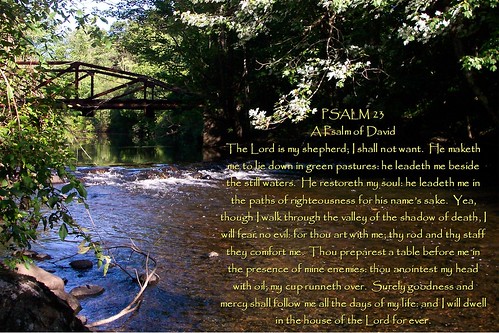
Image by Kurt W. via Flickr
There are times in life that one comes to the edge of what they can know, feel, believe, and understand. It is a bit like standing on the edge of an abyss. There is not much peace in that place. Doubts creep in. You begin to question everything. At times you question why you are here. That is relatively mild compared to the more difficult questioning of your beliefs, your sanity, whether you have been deluded to believe that God exists. If you have not been in this place then consider yourself lucky. It is a lonely place. A painful place. It is a dark place.
I presume that Paul was there on at least one occasion. I base that on his remark:
If we have put our hope in Christ for this life only, we should be pitied more than anyone.
1 Corinthians 15:19 (HCSB)
Most people who have not traveled to the Abyss will quote Pascal's Wager or some version of it. The gist of Pascal's Wager is that God cannot be found based on reason only by faith . Therefore it makes sense to believe as if he existed for one has nothing to lose (if God does not exist) and everything to gain (if God does exist). Pascal's wager stand's in direct contrast with Paul on this point. The fact is if we trust in Christ for this life only then we should be more pitied than anyone. Those that would espouse such an argument trade faith for wishful thinking which leads unbelievers to mock Christianity.
Coming to the edge of the Abyss forces us to the point of questioning and eventual rejecting of things we are unable to reason (knowledge of good and evil becomes our God) or we reach out and find a loving Shepherd longing to love us and guide us (by faith affirming Christ as our Lord). In one sense the Abyss separates the sheep from the goats (Matthew 25:32, Matthew 13:49). A goat (one looking like, but lacking authentic Christian faith) will travel to Abyss and upon seeing his dilemma throw his religion into the abyss and walk away believing (faith in reason not in God) he has done something enlightening. A sheep (on having authentic Christian faith) will come to the Abyss experience the pain, fear, doubt in all its fullness. Then quietly wait in that place for his Shepherd to come find him and lead him out of that place.
The 23rd Psalm
The Lord is my shepherd; there is nothing I lack. He lets me lie down in green pastures; He leads me beside quiet waters. He renews my life; He leads me along the right paths for His name's sake. Even when I go through the darkest valley, I fear no danger, for You are with me; Your rod and Your staff-they comfort me. You prepare a table before me in the presence of my enemies; You anoint my head with oil; my cup overflows. Only goodness and faithful love will pursue me all the days of my life, and I will dwell in the house of the Lord as long as I live.
Psalms 23:1-6 (HCSB)
These words are foolish to the world. They are useless to goats. But to sheep these words are balm to the soul. These words are comfort in times of pain. These words are light in the midst of darkness. These words are assurance in the feeling of loneliness.
"The Lord is my shepherd." We choose him when we come to him in faith. He does reveal Himself to us, but we have a choice to accept or reject Him as our shepherd.
"There is nothing I lack." This seems a strange statement when one is standing next to the abyss. In fact this whole series of pictures is strange next to the Abyss. There are images of "green pastures," "quiet waters," "renewed life," "right paths" and standing next to the Abyss you might say, "Perhaps The Good Shepherd has forgotten me. I seem to have taken a wrong turn somewhere and do not see green pastures, quiet waters, renewed life, nor right paths. In fact I lack very much. God where are in the midst of this dark time?" I believe that David (The one writing the Psalm) is reflecting back on in the past what God has done in his life in Psalm 23:1-3. Looking back beyond the darkness of his present situation he recalls God's faithful provision of green pastures, quiet waters, renewed life, and right paths. And now at this moment that reflection is something that can reaffirm your faith.
"Even when I go through the darkest valley..." Some translation say, "Valley of death." When one travels to the deep abyss one can scarcely imagine walking through it. It is terrifying enough to stand at the edge and look into it. Yet even when we are near this abyss or traveling through it we can be assured of this: the Shepherd is with us and desires to comfort us. With the shepherd nearby we have nothing to fear. David is describing his current situation in Psalm 23:4. Looking at the darkness we see only pain and suffering. Looking at our Savior we have nothing to fear even in the midst of grave danger. With our eyes fixed on the Shepherd we have nothing to fear of doubts and suffering. We have nothing to fear at the end of our reasonableness. We have nothing to fear of our sanity. We had nothing to fear for our Shepherd is in this place. He guides us. If we get to far to the right or the left with a gentle tap from His rod He will get us back on track as we travel this dark time in our lives. What a comfort His rod and staff are when we have reached the end of ourselves and what we can do on our own. Traveling to and through the Abyss can be a gut wrenching experience of this there is no doubt. However, we will have the guidance and presence of God even when all we see is the darkness.
"You prepare..." In Psalm 23:5 David again shifts his focus from the present moment (in the dark valley) to the future. Even our enemies cannot overcome what the Lord has prepared for us. There is leanness right now in this valley, but then will be a banquet table, anointing oil, and plenty to quench our thirst. There is abundance in our future when we walk through this with our Lord. He has prepared it for you. The image of anointing with oil is a symbol of God's selection of you. God has chosen you. He has anointed you for His purpose. You are especially His! Some day His anointing, blessing, provision will overflow to you. His provision waits on the other side for you!
God's "goodness and faithful love" will "pursue" you the days of your life. Walking to the abyss, walking through the abyss, God's unfailing goodness and love pursue you. That is quite a statement. That is boldness that is beyond being reasonable. The world and the goats will say, "Show me the proof and then perhaps I will walk through that valley with you, but you are foolish to think that such a place reveals God's goodness or love. Quite the contrary if God was loving and good the valley would not exist." That is what they will say. They will not understand. They cannot understand walking through the valley because they do not have the Shepherd.
"I will dwell in the house of the Lord as long as I live." Notice the trip to the abyss did not destroy the faith, but made it stronger (Psalm 23:6). Note the resolve that this trip produced. I will dwell...as long as I live. These are powerful words from a person who has been to and through the Abyss. There is no room to pretend that God exists and if he does then He will reward you and if he does not then you have lived a good life. This is utter foolishness. Either you do or you do not choose to dwell in the House of the Lord. There is not phantom faith. It either is true faith or it is not faith at all. The wondrous thing is that once we have made the resolution to trust the Shepherd our weakness will be His strength and He will take care of us no matter how dark it might be.
Blessings to you!
![Reblog this post [with Zemanta]](http://img.zemanta.com/reblog_e.png?x-id=121450ac-8047-4573-9997-448fac6a6966)
Friday, January 29, 2010
Relaxation
One of the most beneficial gifts that you can give yourself in a stress filled world is the ability to relax. You might be saying to yourself, but I do relax. Let me say that relaxation is not an event it is a skill. Anyone can relax under the right circumstances, but to relax when the pressure is on well that is something else. There are many ways to learn relaxation. The key to relaxation is regular and consistent practice
Written Instructions
Anxiety Disorders Association of British Columbia
Written Instruction For Kids
Koeppen, A.S. (1974). Relaxation training for children. Elementary School Guidance and Counseling, 9, 14-21.
Male Voice
Georgia Southern University
Female Voice MP3
Carleton College
My Voice Recording MP3
Written Instructions
Anxiety Disorders Association of British Columbia
Female Voice MP3
Male Voice MP3
UC Santa Cruz
Beach
River
University of Illinois
Forest Stream
Kansas State University
Beach
Forest
Georgia Southern University
Christian Mindfulness
Awareness of Surroundings
Mindful Looking
Mindful Listening
How to meditate on the Bible
Online Bible Topic Index
Relaxation is a skill that will take much practice to become good at it! I would recommend that you spend 1-2 times a day practicing one or more of these methods for about three weeks. After that you can practice 3-5 times a week or when you are feeling particularly stressed, anxious, upset, angry, or irritable.
If you have any questions about this please feel free to write them in the comment section below.
![Reblog this post [with Zemanta]](http://img.zemanta.com/reblog_e.png?x-id=6055ac1e-e8db-46f9-b409-9294ae76f7b3)

Progressive Muscle relaxation
This technique involves the systematic tensing and relax of all the muscle groups of your body. By using this exercise you learn the difference between tension and relaxation and achieve a state of relaxation in the process. Here are some links to help you out:Written Instructions
Anxiety Disorders Association of British Columbia
Written Instruction For Kids
Koeppen, A.S. (1974). Relaxation training for children. Elementary School Guidance and Counseling, 9, 14-21.
Male Voice
Georgia Southern University
Female Voice MP3
Carleton College
My Voice Recording MP3
Breathing Exercises
We do not often pay attention to our breathing until there is something that is restricting it. Then we become immediately aware of how important breathing is. One thing that happens with this lack of awareness of our breathing is that we can develop bad breathing habits. For example fast and shallow breathing tends to increase feelings of anxiety. While slow deep breathing increases feelings of calm. The relaxation through breathing's goal is to make you more aware of this and relax through slow rhythmic breathing. Here are some links to help you out:Written Instructions
Anxiety Disorders Association of British Columbia
Female Voice MP3
Male Voice MP3
UC Santa Cruz
Counting Exercises
Counting can be a great way to get your mind off of a stressful situations and occupy it with something that helps you to relax. There are many counting methods. My preferred method is to count up to 20 slowly 1,2,3,4,5,6,7,8,9,10,11,12,13,14,15,16,17,18,19,20. And then count backwards to 1 slowly 20,19,18,17,16,15,14,13,12,11,10,9,8,7,6,5,4,3,2,1. Repeat this pattern for 3-5 minutes. If you notice that your mind wanders that is OK. Every person that I have tried this with reports mind wander. When you become aware that your mind is wandering gently bring it back to the counting exercise. Other counting Ideas are counting your breaths, counting your steps, count the clock ticking, counting backwards from 100, counting down for relaxation starting with 10 waiting until you feel a deeper relaxation before going to the next number.Imagery
The use of imagery is an effective way to relax. It is like a mental vacation where you travel to a very relaxing place using your mind. When I use this technique I like to go two West Maui at sunset. Here are some links to help you with this exercise:
Beach
River
University of Illinois
Forest Stream
Kansas State University
Beach
Forest
Georgia Southern University
Meditation
Mindfulness
I have written a number of posts on Christian Mindfulness which I encourage you to read. Mindfulness is slowing down to become aware of the world around you. The phrase "Take time to stop and smell the roses" is an example of mindfulness meditation. Here are some links:Christian Mindfulness
Awareness of Surroundings
Mindful Looking
Mindful Listening
Scripture Meditation
I believe that the Bible has words of life. That is to say that the Bible is life giving and life sustaining. Developing a habit of regular meditation on the Bible is good for Spiritual Health as well as for Physical health. Focused meditation on the Bible's instruction for your need will develop a state of peace and relaxation. Links:How to meditate on the Bible
Online Bible Topic Index
Relaxation is a skill that will take much practice to become good at it! I would recommend that you spend 1-2 times a day practicing one or more of these methods for about three weeks. After that you can practice 3-5 times a week or when you are feeling particularly stressed, anxious, upset, angry, or irritable.
If you have any questions about this please feel free to write them in the comment section below.
Monday, January 4, 2010
Emotional Intimacy II

Image by Eden in China via Flickr
Understanding is to good communication as tenderness is to emotional intimacy. Recall that in understanding each person willingly suspends his/her automatic judgment that the other is wrong. They stick to listening until they get it and understand the other person's point of view. Tenderness is the emotional expression of understanding in my opinion. Tenderness creates and emotional atmosphere of safety, care, and concern. This is contrasted with harshness or guardedness which leads to shutting down of emotional intimacy.
This music video is about tenderness .
We often speak a hash word before we have even stopped to think about what we are saying. then in pride we hold fast to our position and just like the song says, "All tenderness is gone!"
Obviously the main way is to avoid harshness and guardedness all together. That requires you to slow down your reactions. I think that most times it is based in a feeling of defensiveness. You have to begin to notice when you are feeling defensive and put the breaks on your mouth. It is quite something to do as the whole process of receiving a message that is perceived as threatening to triggering feeling defensive to a harsh word is literally milliseconds. If you are not good at this right away there is hope. I have seen people learn to do this and become more emotionally intimate with their spouses. First it takes willingness to change this bad habit; then it takes awareness that you are feeling defensive; then it takes extraordinary will power to shut your mouth and listen!!!! It can be done with practice.
The Horse is Out of the Barn
This is very simple! Apologize immediately when you first become aware that harshness and guardedness has crept into the conversation. Don't wait for the right moment, don't try to figure out who is at fault, just apologize. Even if you are only a little at fault. You cannot, You cannot, You cannot have emotional intimacy without tenderness, and apologizing is one of the most tender things you can do when conflict has come up. If you feel that you are right in what you are saying then say something like, "This is not a good time to discuss this subject, but I want to apologize for the way that I reacted to you, it was wrong. Maybe we can talk later when I have had a chance to think it through."
WALK IN GRACE AND BUILD UP
Tenderness is cultivated by sensitive, loving, and caring words and actions. If they do not come naturally to you then here is a list to give you an idea.
| Warmth | Interested Nearness | Gentle Regard Affection Charity Empathy | Attachment Nurture Delight | Benevolence Understanding Indulgence Leniency Devotion | Unselfishness Patience |
So now the encouragement for emotional intimacy is tenderness accomplished when you "Walk in grace and build up" your spouse. May God's Grace grant you the will, wisdom, and strength to accomplish this in your marriage.
![Reblog this post [with Zemanta]](http://img.zemanta.com/reblog_e.png?x-id=fe8eb356-cb06-4174-ae34-276ad8c7eb83)
Friday, December 18, 2009
Communication for Understanding (A Biblical Perspective)

Image via Wikipedia
The mouth of the righteous is a fountain of life, but the mouth of the wicked conceals violence. Hatred stirs up conflicts, but love covers all offenses. Wisdom is found on the lips of the discerning, but a rod is for the back of the one who lacks sense. The wise store up knowledge, but the mouth of the fool hastens destruction.
Proverbs 10:11-14 (HCSB)
The Bible has much to say about communication. We are wise when we use communication in a godly manner. However we become foolish when we do not.
This verse here identifies four aspects of wise communication. First it is a fountain of life. We can speak words of life into the souls of others. Our words literally have power to build up another person. The second aspect is love. More importantly a love that covers up offences. Third is discernment. To me this means that we think before we speak. Thoughtfulness is essential to wise communication. Fourth, storing up knowledge. I believe that this means that we are actively listening receiving the knowledge of others. Listening is vital to good communication.
This is contrasted by poor (foolish) communication. First is the foolishness of not being open with something that is upsetting you. When you conceal violence or thoughts of discontent you are storing it up for some future conversation. These thoughts will be revealed in due time and not usually in a constructive manner. The second example of foolish communication is responding in hatred and strife. Thinking before you talk is contrasted by a person that lacks sense. If you speak foolishly you will receive punishment according to this verse. The opposite of good listening is running of the mouth. Then end of running the mouth is destruction. It reminds me of a saying I heard once:
Better to remain silent and have people think you are a fool, than to open your mouth and remove all doubt.
I know it is a cliche, but there is truth in it.
The one who conceals hatred has lying lips, and whoever spreads slander is a fool. When there are many words, sin is unavoidable, but the one who controls his lips is wise. The tongue of the righteous is pure silver; the heart of the wicked is of little value. The lips of the righteous feed many, but fools die for lack of sense.
Proverbs 10:18-21 (HCSB)
We see a similar theme that reinforces what is in the previous passage here. Wise communication is controlled, righteous, pure, and feeds others. Foolish communication conceals hatred, spreads slander, runs off with the mouth, is wicked, and lacks sense.
A word spoken at the right time is like gold apples on a silver tray. A wise correction to a receptive ear is like a gold ring or an ornament of gold. To those who send him, a trustworthy messenger is like the coolness of snow on a harvest day; he refreshes the life of his masters. The man who boasts about a gift that does not exist is like clouds and wind without rain.
Proverbs 25:11-14 (HCSB)
This passage extends our understanding of wise communication. Timing is everything. You can say the right thing at the wrong time and the effect be the same as saying something foolish. We need to be aware of the timing of our words. Correction is effective when the other person is receptive. It fuels conflict when they are not receptive. Speaking to someone who is not receptive is foolish and a waste of time. Try to understand why they are not receptive and care about their thoughts and feelings.
People don't care about how much you know, until they know how much you care.
Wise communication is trustworthy and refreshing. However foolish communication is like a cloud without rain. Most of us have grown up with a disdain for rainy days. However ask anyone that is in agriculture that having a cloud without rain during a dry spell is very disheartening. In the same way having foolish communication in a marriage that is dry causes despair to set in.
This passage made me laugh (Solomon had a good sense of humor I think), but it is deadly serious:
A person who is passing by and meddles in a quarrel that's not his is like one who grabs a dog by the ears. Like a madman who throws flaming darts and deadly arrows, so is the man who deceives his neighbor and says, "I was only joking!"
Proverbs 26:17-19 (HCSB)
That second part is more applicable to marriage. I have noticed that people will act or speak aggressively and then dismiss his/her spouse's hurt feelings by saying, "I was only joking." This is a form of invalidation. Invalidation destroys healthy conversation.
Praising and cursing come out of the same mouth. My brothers, these things should not be this way.
James 3:10 (HCSB)
When we use communication to bring our spouse down we are destroying the effectiveness of wholesome communication. When "praising and cursing come out of the same mouth" the Bible's edict is quite clear, "These things should not be this way!"
It seems I have some work to do!
 I love you Loverly! I am sorry I do not always do my best to communicate that to you!
God Bless You All
![Reblog this post [with Zemanta]](http://img.zemanta.com/reblog_e.png?x-id=14bb4451-1aa1-4402-ad5c-59fea4241515)
Tuesday, November 24, 2009
Faith Informs Awareness and Action

This will probably be my last post on the topic of mindfulness for a while. it has been an interesting topic to explore and write about. I hope that you have been encouraged as I have from the insights in God's word.
But know this, that if the master of the house had known what hour the thief would come, he would have watched and not allowed his house to be broken into.
Matthew 24:43 (NKJV)
This may seem an odd verse to end on for mindfulness. However, I believe it points to the contrast of being unmindful. If we are aware that something bad could or will happen then we will take action to do something about it. It is this awareness that leads to action. Jesus goes on to say:
Therefore you also be ready, for the Son of Man is coming at an hour you do not expect.
Matthew 24:44 (NKJV)
As Christian's our faith is in the person Jesus Christ God's one and only begotten son. Jesus used the title "Son of Man" as a reference to Himself. So Jesus is telling us that some day He will return. He also is telling us to live in a state of readiness for that very return. Our faith in Christ informs our awareness in spiritual and life matters. This is not limited to our faith in His return or our eventual resting place with him, but this ought to be central in our consideration. This faith awareness is the root of Christian mindfulness.
From this mindfulness proceeds some sort of activity. Faith without action is like telling stomach without food be filled and expecting relief.
If a brother or sister is without clothes and lacks daily food and one of you says to them, "Go in peace, keep warm, and eat well," but you don't give them what the body needs, what good is it? In the same way faith, if it doesn't have works, is dead by itself. But someone will say, "You have faith, and I have works." Show me your faith without works, and I will show you faith from my works.
James 2:15-18 (HCSB)
Becoming aware will ultimately lead to some sort of conviction (by the Holy Spirit). That conviction will require some action if it is to be followed. Being mindfully aware of yourself and the world around you may bring some state of bliss or pleasure, but without a change that plays out in your daily walk it is not very useful. Mindfulness without some corresponding response seems hedonistic in my estimation. It is seeking pleasure over right living (righteousness). Mindfulness may bring a sense of transcendence and peace, but if it does not bring you into a right relationship with God then it is not true Christian Mindfulness.
God Bless You all!
Next Topic Marriage Relationships
Friday, November 20, 2009
Setting Your Mind on the Spirit
For those of you who have been following this I must apologize for the delay in getting this post out. I have had many things to attend to that seem to be now resolved to a certain extent. So I am now able to return to writing.
Romans 8 is one of the most powerful chapters in proclaiming our spiritual victory found in Christ. In Chapter 7 Paul discusses the futility of willing yourself into victory. Willpower does not save. If willpower was all that was needed then the message of the Cross is pointless. When the will is set on the Spirit (Spirit mindedness) then the Spirit's power is set forth to do it's work in the life of a believer.After repentance (Dying to self and turning to Christ) then one must accept the truth that there is now no condemnation for those that are in Christ Jesus. So often we tend to get our spiritual cleaning and then go back to the works of the law. Or continue to beat ourselves for past sin. The removal of guilt is complete. That is not to say that you will not experience consequences of sin (sometimes life long). But it does mean that you are free spiritually. Your freedom is an accomplished work that Christ did for you on the Cross.
At this moment of spiritual freedom you have some choices on what you are going to focus on. Walking in the Spirit, living in accord with the Spirit, mindset on the Spirit, Crying out in the Spirit, groaning in the Spirit, Hoping in the Spirit, Waiting in the Spirit, and praying in the Spirit are all disciplines that lead to greater and greater Spirit mindedness. There is considerable overlap between these disciplines.
What the law could not do since it was limited by the flesh, God did. He condemned sin in the flesh by sending His own Son in flesh like ours under sin's domain, and as a sin offering, in order that the law's requirement would be accomplished in us who do not walk according to the flesh but according to the Spirit. For those who live according to the flesh think about the things of the flesh, but those who live according to the Spirit, about the things of the Spirit.
Romans 8:3-5 (HCSB)
"Walking according the the Spirit" and "living according the the Spirit" is an intentional change from doing what feels good (in the moment) to falling under the direction of God's Holy Spirit. This is not the same as willing to be obedient to God's Law, but rather it is choosing to follow His Spirit to be in accord with God's plan for your life. There is a slang expression "I am down with that." In some sense we as Christians are to be "down with the Holy Spirit." We (with our will) are in agreement with His direction for us. That is walking according the the Spirit. Our walking and our lives are with the Holy Spirit!
For the mind-set of the flesh is death, but the mind-set of the Spirit is life and peace. For the mind-set of the flesh is hostile to God because it does not submit itself to God's law, for it is unable to do so.
Romans 8:6-7 (HCSB)
Part of the act of the will in being in accord with the Sprit has to do with where your mind is set. There is a contrast between a person that has their mind set on the flesh and their mind set on the Spirit. This is a very important distinction. I am convinced that as long as a person continues to think about sin either in terms of avoiding it or indulging it the mind continues to be set on the flesh. Did you catch that? You can be desiring a good thing (avoiding some particular sin) and still have a mind set on the flesh (remember Romans 7). There is a need to set our minds on the Spirit of God. Our ultimate life and peace come from this act. Think over the times of spiritual victory in your life and you will find that they did not come from working harder to avoid sin, but rather when you were able to set your mind on the things of God. The opposite is also true. Think about the times of spiritual defeat. You were no matter how hard you tired not to unable to beat the sin because it was on your mind. Having the right mind-set is vital to a Spirit filled life. Where is your mind set?
For you did not receive a spirit of slavery to fall back into fear, but you received the Spirit of adoption, by whom we cry out, "Abba, Father!"
Romans 8:15 (HCSB)
When we come to Christ as our savior then we receive the Holy Spirit as evidence that we have been "adopted" into God's family. It is by this Spirit that we are able to call God our daddy and father. There are times in life that we just need a daddy to get us through the moment. To pick us up dust of our pants and let us know He is right there with us holding us up with His strong arms. It is through Spirit mindedness that we can experience this spiritual hug from God. Go ahead cry out to Him. He loves to hug His children!
And not only that, but we ourselves who have the Spirit as the firstfruits -we also groan within ourselves, eagerly waiting for adoption, the redemption of our bodies.
Romans 8:23 (HCSB)In the same way the Spirit also joins to help in our weakness, because we do not know what to pray for as we should, but the Spirit Himself intercedes for us with unspoken groanings.
Romans 8:26 (HCSB)
There are times when all that we can let out is a groan. For the Christian there is a groan of desperation and hopelessness (Groaning in the flesh?) and there is a groaning in and by the Spirit. The groaning in the Spirit come from the realization that this is not our final resting place. We long to be with God in total. We desire the day when we will be able to shed this sinful flesh and be fully redeemed and with God. There also is a groaning that is done by the Spirit Himself. He groans a prayer over our groaning of weakness. This type of groaning is actually a prayer. Praying in the Spirit is a prayer of speechlessness for ourselves, but the words of the Spirit are powerful. If you have never prayed according the the Spirit in this way I encourage you to get quiet before the Lord acknowledge your weakness and let the Spirit do the rest. The key is that it is the Spirit's work because of our weakness and not something that you do in yourself! The prayer in the Spirit is powerful. Prayer without the Spirit is just a list of things that you want God to do. God always answers the first prayer, but the latter He may or may not. These verses explain was praying in the Spirit is answered.
And He who searches the hearts knows the Spirit's mind-set, because He intercedes for the saints according to the will of God.
Romans 8:27 (HCSB)
When we pray in the Spirit and the Spirit groans on our behalf then we get a perfect prayer that is according to the will of God. This takes discipline and it certainly takes sensitivity to the Spirit's leading, but it can transform your life of prayer.
There are many more disciplines that lead to Spirit Mindedness, but I believe that this is a good start. One thing before a end this post. My worst fear is that you would take my words to be something. In reality they are nothing. They are less than nothing compared to the surpassing value of God's word. I ask you with the greatest of urgency and sincerity to examine His word. In this case specifically Romans 8. Before during and after your reading of Romans 8 ask that God would give you Spiritual understanding and wisdom. It does not come from me nor can I replace His Spirit. May the God of all creation and savior of our souls grant you the wisdom of the ages!
God Bless You!
Wednesday, October 7, 2009
Fancy Flights
 Unreservedly giving yourself to God involves being committed to do it today. Often I hear Christians (at times myself) telling me what they are planning to do someday for God. The fancy flights are not any more mindful than worrying about the future. Even though they make have a feeling of good will, they do not accomplish much based on my observations.
In a way fancy flights are boasting before the actual act has occurred. We say I will go do such and such for God. One of the difficulties is that we do not know what tomorrow holds. Our hearts go out to the family that just lost a young daughter this week. Their loss has affected our family. Life is like that. Three weeks ago we had no connection to the family and now we are grieving with them as they wrestle with this loss. It reminds me though about how uncertain we can be about the future.
Another problem with fancy flights is that tomorrow never comes. It is always a perpetual tomorrow. It is a little different than procrastination. Procrastination is putting off something that you don't want to do. Fancy flights are planning to do something that you want to do, but never taking that first step or following through. I still struggle with this myself, but by God's grace I am getting better. Trust me I still have much room to grow in this respect. those that know me well will testify to this.
The cure of fancy flights (verses)
- Daily prayer (Matthew 6:11)
- Discern what God is doing today (Matthew 16:23; Luke 19:5)
- Do not harden yourself with sin today (Hebrews 3:12-13)
- Encourage another person today (Hebrews 3:12-13)
- Plan your tomorrows with speculation (not certainty) in light of God's will, and do good while it is today (James 4:13-17)
God bless you all!

Saturday, September 5, 2009
Personal Note
 I took a few more days off this week to do some self-awareness and discovered that what I was missing was awareness of God. It seems that I was doing some fighting again rather than trusting God. God has been so good to me. Every time I have a need He has provided in some manner. At times I get caught up in my circumstances get my eyes off of Him and thereby increase my suffering. Why is it that we humans have such a natural affinity to blame God when things are not going the way we want? Worse why do we question Him when He has proved Himself over and over?
 There was a few of areas of my life that I have been lacking mindfulness in the last couple of months. I was in a mental fog in regard to these. In the last couple of days God has answered my questioning prayer (Thank you God for being so gracious to my presumptuousness). In one of those prayers I was so bold as to say "I am doing what you called me to do, Why are you not taking care of me and my family!" As I type those words I am a bit ashamed to admit I prayed them now.
There are times when we put our head in the sand when there is something that we do not want to deal with. In a previous post I talked about the types of mindlessness. I think I can now add another that I just realized, intentional mindlessness. Sometimes we willfully avoid something that we do not want to look at. It can take the form of escapism, simple mindmindlessness, busyness, egoism, but at its core is a willful avoidance of something that is painful to think about. I discovered this week that if you do this long enough then you can turn it into a lack of awareness of what God is really doing in your life.
When I took my head out of the sand and looked at the reality of the situation, within the next 24 hours He showed me that my perception was way off. He showed me that not only had he taken care of me, but he also had done more than I had expected. God had been working amazingly and instead of praising Him I was questioning Him! Lord forgive me I do praise You for your mighty work in my life. With this new awareness I was able to more effectively deal with the problem. I realize that one of the biggest factors was my intentional mindlessness. If I had paid better attention the problem of perception as well as the actual problems it caused in my life could have been avoided.
Have a Blessed Weekend!
Wednesday, September 2, 2009
Peace of God
 I typically get up very early to start my day. Today I got up at 3:30 AM. There are three reasons for me to get up this early. First is habit. Once I start getting up at a certain time I have a hard time sleeping past that time. Second is to spend time with God. Third, it is the most quiet time in my house. With four children there is no peace when they are awake.
 Peace and Quiet is a common expression. As near as I can tell the idiom originated in the mid 1800's according to American Heritage Dictionary of Idioms. Interesting to think about when you consider the changes that the western world was going through at the time. The Second Great Awakening, Rise and fall of empires, Latin America's struggle for freedom from imperial rule, rise and fall of Napoleon, Many other wars on every continent of the world, the industrial revolution, Communist manifesto published, revolutions of 1948, California gold rush, Origin of Species published, American Civil war, the end of slavery in most all major empires, Lincoln Assonated, The second industrial revolution and so on. Interestingly by the mid 1800s the noise from machinery alone may have driven one to say in exasperation, "All I want is a little peace and quiet."
Now we have more noise than ever. It is informational, technological, political, commercial, legal, spiritual, mechanical, medical, and I am sure that I missed some. In the midst of the cacophony we to long for a bit of "peace and quiet." Even in this quiet moment I still hear cars outside, machines at a plant about half a mile away, clock ticking, the hum of the refrigerator, the whoosh of central air, and the whir of the computer. So even in my quiet I continue to be bombarded by noise.
In some respects we have become accustom to our noise. In some ways it is actually comforting. Have you ever been at home when the power goes out? The phrase eerie quiet comes to mind. Eerie? Really? How about natural quiet. A quiet that comes from an absence of man's noise. How about a peace "not as the world gives," but as the Lord gives.
Let's contrast "peace of the world" with "peace of God." Peace of the world is conditional. Peace of God is given freely to them that would receive it. Peace of the world is maintained by agreement and/or enforcement. Peace of God is maintained by covenant and seeking. Peace of the world is temporary (fictional perhaps, no time without war). Peace of God is eternal (though remaining incomplete in this life). Peace of the world is externally controlled by the circumstances and relationships in life. Peace of God is internally controlled by relationship with God's Spirit and transcends circumstances in life.
Jesus Said:
The Counselor, the Holy Spirit -the Father will send Him in My name-will teach you all things and remind you of everything I have told you.
Peace I leave with you. My peace I give to you. I do not give to you as the world gives. Your heart must not be troubled or fearful. John 14:26-27 (HCSB)
I am not alone, because the Father is with Me. I have told you these things so that in Me you may have peace. You will have suffering in this world. Be courageous! I have conquered the world. John 16:32-33 (HCSB)
Peace of God is connected to our relationship with Him. We have peace toward God through our relationship with Jesus Christ. We receive God's Holy Spirit who give us peace through trouble, frightening times, and suffering. Peace of God is cultivated through being peaceable, lenient, compliant, bulging with mercy and good fruits, and avoiding favoritism and hypocrisy. Peace of God comes from fellowship with other believers. Finally Peace of God is deeply connected to Holiness. Without repentance from evil and pursuing that which is good Peace of God is unreachable.
Go now and pursue peace. Not the peace the world offers, but the peace of Christ that is found in setting you mind on the Holy Spirit of God.
Blessings and Peace
Tuesday, September 1, 2009
Quiet Mindfulness (Spiritual Ritalin)
 Long long before the rise in popularity of eastern mindfulness in the west, western religious teaching put forth contemplation as a mode of peaceful interaction with the world, people, and God. In this tradition quietness and peacefulness were major objectives of prayer, meditation, activity, and worship. Somewhere along the line this contemplative spirit was diminished or perhaps men of old just wrote about it and few (just like today) ever practiced it. I suspect the mindlessness of busyness is one of the major reasons we do not Practice the Presence of God now. This activity has driven the church to distraction from the purpose that God has given her. In this post I hope to point out the need for contemplative awareness.
 Be still, and know that I am God: I will be exalted among the heathen, I will be exalted in the earth. Psalms 46:10 (KJV)
Why is it that I have such a hard time being still. I have quipped a few times that if I was in school today that I would be a candidate for stimulant medication to treat may ADHD. I have not been diagnosed, but I have to admit the signs are there.
The core qualities of ADHD are inattention, hyperactivity, and impulsivity. This is not a slam on people with ADHD, but I cannot help but recognize that ADHD is a serious barrier to mindfulness. Interestingly mindfulness strategies have been helpful in my practice of counseling, my life, and my spiritual development.
I think the Church has Spiritual ADHD. Let me demonstrate by going through my diagnostic criterion for "Spiritual ADHD."
Inattention
(a) often fails to give close attention to details or makes careless mistakes
(b) often has difficulty sustaining attention in ministry
(c) often does not seem to listen when spoken to directly
(d) often does not follow through on instructions and fails to finish the work it is called to
(e) often has difficulty organizing tasks and activities
(f) often avoids, dislikes, or is reluctant to engage in tasks that require sustained mental effort
(g) often loses things necessary for tasks or activities (e.g., Bible, Prayer, Holy Spirit, discipleship, or evangelism)
(h) is often easily distracted by extraneous stimuli (mind set on the world)
(i) is often forgetful in daily activities (prayer, Bible reading, quiet time)
Well I started this out a little tongue and cheek, but it seems uncanny how much of this applies. Let see what Hyperactivity turns up.
Hyperactivity
(a) often fidgets with hands or feet or squirms in seat (especially if feeling convicted)
(b) often leaves the vine in situations in which remaining in the His word is expected
(c) often runs about or climbs excessively in situations in which it is inappropriate (in adolescents or adults, may be limited to subjective feelings of restlessness; really I am not poking fun of Charismatic's here ;-)
(d) often has difficulty playing or engaging in leisure activities quietly
(e) is often "on the go" or often acts as if "driven by a motor" (though we are not sure where they are going)
(f) often talks excessively
Yikes I still have one more category. I starting to feel a little squirmy myself!
Impulsivity
(g) often blurts out answers before questions have been completed (or understood)
(h) often has difficulty awaiting turn
(i) often interrupts or intrudes on others (e.g., butts into conversations or other's lives when not welcomed)
Wow I am convinced that the Church has full on ADHD. Especially when you consider that you only need 6 of the above persisting for 6 months. I think I could easily make the case for all 18. God I need some Spiritual Ritalin.
Seriously though the Church is broke. There is no way around it. We need to get back (if we were ever there) to the quietness of God. "Be still and know that I am God!" This stillness holds the key to overcoming our tendency to be distracted by the things of this life. Quietness holds the key to our tendency to act without thought or purpose. Knowing that He is God will guard us from impulsively saying and doing things that bring shame to the cause of Christ.
More on quietness tomorrow.
Subscribe to:
Posts (Atom)