Showing posts with label Human. Show all posts

Thursday, April 1, 2010

Judas Kiss of a Friend?

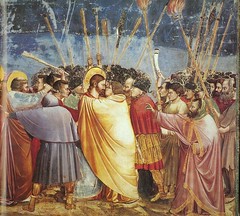
Kiss of Judas * Giotto di Bondone

Image by Carla216 via Flickr

His betrayer had given them a sign: "The One I kiss, He's the One; arrest Him!" So he went right up to Jesus and said, "Greetings, Rabbi!' and kissed Him. "Friend," Jesus asked him, "why have you come?" Then they came up, took hold of Jesus, and arrested Him.
Matthew 26:48-50 (HCSB)

In looking at the friends of Christ I cam across a very peculiar verse in which Jesus calls Judas a friend.  The timing of this statement is even more peculiar as it is the moment of Judas' betrayal of Jesus into the hands of the Pharisees.

I looked up the Greek in this case and the issue seems to be resolved in that once again English is a poor description of the Greek.  There are two Greek words that are both translated to friend in English.  The first one, philos, is the most common and fits with our usual meaning of the word friend, kindness, and affection (see Luke 14:12; Luke 15:6; John 11:11; John 15:14).  The second one, hetairos, which carries a slightly different meaning.  Here (Scroll down to hetairos) is a good section from a book that helps to draw out the difference.  It seems that hetairos is a companion and the nature of the relationship is derived from the context.  In other words you can have a companion that is a dear friend (philos hetairos), a companion that is joined together with you in a group or purpose (hetairos), a companion can be someone that you come together with (invite for dinner for example),  a companion can also be a person of bad reputation, a companion can be with a person that does not have your best interests at heart.  It is this generic hetarios that Jesus calls Judas.

It seems to me that this is more a verbal barb than a term of endearment in this case.  What makes this word even more interesting is that it is only used two other times (Matthew 20:13; 22:12).  In Matthew 20:1-16 is the parable of the vineyard owner.  In Matthew 22:1-14 it is the parable of the wedding banquet. 

In this the vineyard owner hires five different groups of laborers through out the day so that the first group hired works all day and the last group hired only one hour.  The first group negotiated a contract for a days pay.  At the end of the day the vineyard owner went to settle accounts.  He started with those that worked only an hour and ended with the group that worked all day.  He paid them all a days pay.  The ones that worked all day believed they were being cheated even though they were paid the amount that they agree to work for.  The vineyard owner calls the complainers friend (hetrairos).  We see this happen in church at times (sad to say) when we see God blessing someone else and feel that some how we have been cheated.  We should praise God for his generousness whether we are the recipient of that blessing or other are ones to receive.   Needless to say the complainers were not friends in the fondness or affection sense.

In the wedding banquet the King plans a celebration for his son.  He sends out an invitation; however the people are too busy to attend.  Another group kills the messengers and the king in turn destroys their cities.  He says that they are unworthy of coming to the banquet (either by neglect or by outright hostility) and so he send the invitation to anyone willing to come to the banquet.  Now this banquet was a very special affair and required the appropriate attire.   This presents a problem for those that are in the "general public" in that they do not have the appropriate attire.  The good news is that a appropriate suit was provided.  This friend (hetrairos) refused the offer and attended the banquet in his own clothes.  The application of this is that the garment is the righteousness of Christ/God (see Zechariah 3:4).  When this man showed up in his own street clothes he was saying that his righteousness was sufficient to be a worthy guest.  God says otherwise.  It is in this vein that Jesus calls Judas friend.

What can we take away from this.  Well Jesus companioned with people, by treating them with dignity, respect, and supplying their needs.  He even served Judas (see John 13:2, 3, 4).  In other words Jesus did not distinguish in behavior from a dear companion or a companion about to betray him.  However, he did have a difference in His heart.  Judas was not a dear friend, but rather a companion.  Jesus had guarded himself by putting Judas at an emotional distance.  Now it is fair to point out the Jesus was perfect and we are not.  But I truly believe that the events leading up to the crucifixion of our Lord are some of the most revealing of his humanity.  What is more if we get a glimpse of Jesus perfect in humanity then we get a glimpse for our own humanity as God intends for us.  If Jesus handled it in this manner then far be it from me (a follower of Christ) to suggest that he or I should handle it differently. 

May I have within me the Spirit of the Living God in such fullness that if I face a similar situation that His Spirit would guard my heart in the face of betrayal even betrayal of a dear friend.  May I be clothed in the righteousness of Christ so as to act in a saintly manner and perform works of goodness without regard to others status of friend or enemy.  It is a high calling; in my own strength I cannot, but with God all things are possible. 

Blessings to you!

Reblog this post [with Zemanta]

Wednesday, March 17, 2010

Circles of Confidence part II

The god mostly pray in touch the legs in heart...

Image via Wikipedia

Friends of Christ

No one has greater love than this, that someone would lay down his life for his friends.
John 15:13 (HCSB)

Before we look at some of the friends of Christ I want to examine his teaching on friendship.  At the heart of friendship is a love that is sacrificial.  Without sacrificial love there can be no greater confidence and intimacy has reached its limit.  There are people who can live this way.  They have enough confidence in humanity to accomplish particular tasks (eg fellow workers), but they never go beyond.  Their circle of confidence never allows for others to come near them.  In doing this they protect themselves from being hurt.  However they tend to live lives of isolation and loneliness. 

You are My friends if you do what I command you.
John 15:14 (HCSB)

This verse can have double application I believe.  Jesus' is clearly saying when we love with a sacrificial love then we are His friends.  I think by implication when we do not love this way then we are not acting like friends of Jesus.  The other application I believe is that a friend will fulfill the request of another friend.  Don't get me wrong we must hold Jesus in higher regard than other friends, but if a friend asks you to do something and you do not do it then how is it that person is your friend.  In this way it seems to me that most friendships are killed by neglect and not by angry actions. When what we do does not match up with what we say or believe then we lack integrity.  This lack of integrity is destructive to relationships.  For example, If I say I believe in the Grace and Forgiveness of God, but I do not treat others graciously or in a forgiving manner then I lack integrity and people will question and/or reject my friendship and I am rejected by God (See Matthew 18:32-35). 

...I have called you friends, because I have made known to you everything I have heard from My Father.
John 15:15 (HCSB)

A friend is a person that shares important parts of what they know.  Openness is a good measure of friendships.  When a person starts to withhold information from another then friendships wither.  A lack of openness usually is a good measure of a lack of confidence.  This lack of confidence can be in certain areas of the relationship.  For example I may have high confidence that a friend will help me with a job around the house, but low confidence that they could help me with a emotional problem.  That is OK.  We will see that Jesus had fewer people that He put higher confidence in than those who were simply His friends.  So varying degrees of confidence is not a bad thing in itself. 

In this Jesus is making known to his friends what He is hearing from our Heavenly Father.  We to can make intimate things know about our relationship with God as well as intimate part of our lives.  As our confidence grows then so does our ability to be intimate in our relationships.  Jesus did not do this with everyone though.  In the same manner we need to discern who is a friend and who is not. 

You did not choose Me, but I chose you...
John 15:16 (HCSB)

Here we can again see a double meaning in this passage.  Jesus is saying that he chose His friends to be the continuation of His ministry here on earth.  His friends were going to establish the Church and tell others about the Good News of Salvation through Christ.  It also says that Jesus chose His friends.  In the same manner we to should choose our friends.  All to often people let others to choose them as friends.  Sometimes they are lucky and other times not so.  Keeping your eyes open and paying attention to how people talk about other, how they treat others, and to a certain extent trusting your convictions is a good way to discern who would be a good friend. 

In short then Jesus teaches that friendship involves sacrificial love, willingness to do things that a friend asks, openness, and a choice (discernment) of friends.  God willing I will look at the people that were friends of Christ.  God Bless You.

Reblog this post [with Zemanta]

Friday, September 25, 2009

Just a little further

falling down Image by laurenmarek via FlickrI was in prayer a few weeks ago thanking the Lord for the blessings in my life.  I had been fighting with God and not aware of what he was doing in my life.  During this prayer there was a distinct communication of His Spirit to my spirit, "Are you ready to take it to the next level?"  In prayer I answered "Yes Lord." 

God started that week by showing me some things through my counseling clients.  I cannot go into detail because of their confidentiality, but I can say that God was revealing, "here are the hurting people that I want to heal."  Notice not not the people I want "you" to heal, but the people God wants to heal!  I must admit it is a wonderfully rewarding feeling to see someone recover from what life has thrown his/her way, but can I really take credit for that?  Not really. As Christians we are reflections of the light of God.  We are workers in the field of life, but the glory is the Lord's.

"You are the light of the world. A city situated on a hill cannot be hidden. No one lights a lamp and puts it under a basket, but rather on a lampstand, and it gives light for all who are in the house. In the same way, let your light shine before men, so that they may see your good works and give glory to your Father in heaven."
Matthew 5:14-16 (HCSB)

Unreservedly giving yourself to God is this; I choose to let my light shine for myself, no!  I will forgo the praise that men will place on me.  I will work even when no praise is coming my way, for my master.  In the public I will work diligently, with endurance, with greater grace than I can muster within my own spirit, but with graces and mercies that God's Holy Spirit gives me.  To what end you ask?  Not that others might give glory to me (you are such a good person), but rather that they will give glory to my Father in heaven (Praise to God in the highest). 

But then there is the "higher level." 

"For My thoughts are not your thoughts, and your ways are not My ways." This is the Lord's declaration. "For as heaven is higher than earth, so My ways are higher than your ways, and My thoughts than your thoughts."
Isaiah 55:8-9 (HCSB)

Giving yourself to God is quite easy and natural when we are basing our decision on His loving-kindness, grace, and mercy.  Ironically we are very comfortable with the sacrifice of our savor, but not with the sacrifice of self.

Other seed fell on rocky ground where it didn't have much soil, and it sprang up right away, since it didn't have deep soil. When the sun came up, it was scorched, and since it didn't have a root, it withered...

...And these are the ones sown on rocky ground: when they hear the word, immediately they receive it with joy. But they have no root in themselves; they are short-lived. When pressure or persecution comes because of the word, they immediately stumble.
Mark 4:5-6; 16-17 (HCSB)

This happened to me over the last couple of weeks.  I will not go into detail, but suffice it to say the pressure and persecution were on.  At one point it was more within than outside.  I recall praying, "Lord I am quite comfortable as your apologist, but this thing You are showing me in Your Word, I have a hard time accepting.   To be honest until yesterday morning I had not yet accepted it!  Now the writer's block comes together (only 5 posts in the last 3 weeks, compared to 15 the three weeks before that).

Let me ask you, Is God showing you something that you have a hard time accepting?  Is it easy to receive the graces of God with great joy, but the trials, temptations, sorrowful moments, the ugliness of life, causes you to stumble?  You can either continue to have a God of the good times while you remain lord of the low times or you can unreservedly give yourself to God.  Will you commit to follow Christ for better or for worse, in sickness and in health.  Will you marry yourself To God's plan and purpose for your life and the Blessings along with the longings.  If you do then that is unreservedly giving yourself to God!

I have decided to follow Jesus;
Though I may wonder, I still will follow;
The world behind me, the cross before me;
Though none go with me, still I will follow;
No turning back, no turning back.

Will you decide now to follow Jesus?
No turning back, no turning back.

God Bless You All

Thursday, July 23, 2009

The Devil's Grammar Lesson

image 1 Now the serpent was the most cunning of all the wild animals that the Lord God had made. He said to the woman, "Did God really say, 'You can't eat from any tree in the garden'?"

2 The woman said to the serpent, "We may eat the fruit from the trees in the garden. 3 But about the fruit of the tree in the middle of the garden, God said, 'You must not eat it or touch it, or you will die.' "

4 "No! You will not die," the serpent said to the woman. 5 "In fact, God knows that when you eat it your eyes will be opened and you will be like God, knowing good and evil." 6 Then the woman saw that the tree was good for food and delightful to look at, and that it was desirable for obtaining wisdom. So she took some of its fruit and ate [it] ; she also gave [some] to her husband, [who was] with her, and he ate [it] . 7 Then the eyes of both of them were opened, and they knew they were naked; so they sewed fig leaves together and made loincloths for themselves.

The title of my sermon this morning is "The Devil's Grammar Lesson." As I have already mentioned this morning's sermon is going to be a bit technical so if it feels more like a lecture than a sermon than forgive me. I do have a purpose in tackling this passage in this way though. You see our biggest barrier to personal holiness is sin. I believe that looking at the original sin that we can learn something about the nature of temptation and falling that we then can apply to our own lives and work on the sanctification (that is personal holiness) that God desires from his children.

This is of course the dialog between Eve and Satan in the garden of Eden. This conversation though only a few verses in length has had a profound affect on the whole of creation and the lives that we live today. At this point in the account of God's creation of the world we have seen that God has created everything and that it was good. Sometimes that word good seems so plain. I think that in the age of super, fantastic, perfect, outrageously fun, hot, excitement, wonderful, superb, blowout, greatest things competing for our attention and for the money in our pocketbook, we miss out on the good that God has to offer. Frankly God's goodness is incomparable to the wealth and wonderment that this world has to offer, and blessed are those that find it. So His creation was good. We also have seen that God has created a woman to be with man and that they have a perfect bond of love with no shame. Then enters the serpent into this land of God's goodness.

Here is an aside. Isn't interesting that the Devil and the angels that follow him seem to insert himself into our lives when we are experiencing God's goodness. Have you ever noticed that. The scriptures rightly call him a thief. He does in fact come to rob, kill, and destroy. His target is God's goodness.

So we have the devil enter this scene. I am going to use a word for word translation from Greek to aid in our discussion. Word for word translations are useful when looking at the grammar in Greek since English translations do not always capture the nuances of the original languages. The draw back of word for word translations is that they sound very choppy since we are not accustom to the grammatical structure of Greek.

The devil starts out by saying, "Indeed! that He Elohim said.." There was no formal introduction, no building up to the presentation. No chance to warm up. He right out of the gate begins his criticism of God's word. Indeed. "Af" in the original language. My interpretation would "Aw, Did God really say..." His criticism was not really from a place of understanding what God had said, but rather the intent was to call into question what God had said. We have this happening with regularity in our modern times. Every where we look we find people actively criticizing the Bible and what it says, not because they want to understand it better, but rather because they want to call it into question. There is a process of understanding the Bible called textual criticism which the primary goal is to challenge the text and press to see if the text is really saying what we think that it says. Don't get me wrong. I believe that we should wrestle with God's word until though His Holy Spirit we arrive at a deeper and more meaningful understanding, but when we call into question the things that are plainly understood in the Bible then it is not a new understanding, it is the old rebellion that was initiated by the devil himself.

He says next, "Not you shall eat from any tree in the Garden." I would like to compare this to what God said and note how the Devil works in distorting the word of God. Remember the power of Satan is not is some magnificent awesome forcefulness to inflict pain and suffering, but rather deception. Deception is the most powerful tool that the devil uses against people. What God really said was "From any tree in the garden to eat you shall eat." Notice that the serpent states God's provision in the negative. I believe that the serpent is trying to get Eve to look away from the generous provision that God has given. God said that from any tree to eat you shall eat. This double eat is a statement of abundance and blessing. God's goodness was an abundant blessing, but that is not what the serpent wanted Eve to focus on, so he starts out by saying God's provision in the negative. If she were facing some uncertain medical crisis he might say, "Surely God didn't say he would heal you?" If she were facing some finical crisis he would say, "Come on, God couldn't have said that he would give you abundant life." If a person was facing a relationship crisis he might say, "Surely God does not intend for you to love him?" The devil loves to state God's provisions and commandments in the negative. He causes Eve (and us when we buy into his lie) to question our own understanding of what God has said.

Notice Eve's response. "From the fruit of the trees of the garden we are eating." She nailed it. Her understanding of what God had provided was right on target. Notice she said "we are eating." This makes me believe that Adam is right there with her. Often times much is made of the woman being the first to sin, but Adam actually made the first mistake by not protecting his bride from this deceiver. Anyway, if she got it right then what happened? For starters she did not state the double provision that God had given them. That is to say she missed that God was not only fulfilling her need, but he was doing it abundantly. But her straying from what God has said goes further.

Notice what she says next, "but from the tree which in the midst of (literally center) the garden he said Elohim not you shall eat from it. Let's compare that to what God really said. "and the tree of the lives in the midst of (center) the garden." Notice how by introducing the thought of what God was withholding from her by stating his provision in the negative, how the devil has replaced the center of attention from the tree of life. God says that the tree of life is at the center of the garden and mention the tree of the knowledge of good and evil as being there. Eve now refers to to the tree of knowledge of good and evil as being the center of the garden and does not mention the tree of life.

How often we focus on the one thing that God has not given to us. We are unaware of the wonderful blessings that He has poured out in our lives and we choose instead to center our attention on the one thing we do not have, or that God has told us in not for us. Every tree was available and the tree of life was at the center, but now the center of her universe was the forbidden tree. Sad really to think about how much of our joy is robbed from us when we choose to focus on the forbidden. In short the devil's deception has worked. Eve is no longer has a clear understanding of what God has said; instead it has been replaced with a distorted understanding of who God is, namely He is withholding something from you.

Continuing on she says, "and not you shall touch it." No where did God say that Adam and Eve were not to touch this tree. Eve is adding on to what God said. You see adding on to what God has said can be as dangerous as taking away from what He has said. In some respects we see the roots of legalism in this statement. Legalism is a set of rules designed to keep a person from offending God by preventing unholy action. It sounds like a good idea at first, but the reality is that Legalism does not produce holiness. The only thing it accomplishes is a sense of self-reliance in that it creates a false belief that we through our actions independent of God can please Him.

Next she says "lest you shall die." When we compare what she is saying to what God has said we find the other mistake of taking away from God's word. God said "in the day of to eat of you it to die you shall die." The difference is subtle but it is very important. God states the certainty of death by saying "to die you shall die." Eve on the other hand state the likelihood or possibility of dying. I mentioned last week that we do not fear the God of the New Testament and that in fact God is the God of both Testaments. He has not changed. Like Eve I think we toy with the possibility of judgment rather than the certainty of it. Let me make this clear unless you repent of your sin you will face God's judgment! That is a certainty not a possibility. Parable?

Next the devil says, "Not to die you shall die." This is a direct contradiction of God's words. He goes on to say that if she eats of the fruit that her eyes will be opened. Open your eyes. This reminds me of the arguments that people give in protecting our children. You might hear things like, "You can't shelter them forever." or "That is old-fashioned." Don't get me wrong opening your eyes is a good thing, but what is it that you are allowing into your soul? Luke 11:24-36 says

34 Your eye is the lamp of the body. When your eye is good, your whole body is also full of light. But when it is bad, your body is also full of darkness. 35 Take care then, that the light in you is not darkness. 36 If therefore your whole body is full of light, with no part of it in darkness, the whole body will be full of light, as when a lamp shines its light on you."

That phase take care then that the light in you is not darkness. This tells me that there is false light. In this case there is false openness that leads to your whole body, your whole life being filled with darkness. The devil was not lying when he said your eyes will be opened, but he was deceiving her by making is sound like a good thing.

Satan goes on "that one knowing Elohim that in day of to eat of you from it and they are unclosed eyes of you and you become as Elohim ones knowing of good and evil." Interestingly the devil is not lying here technically, but he most certainly is deceiving. The serpent is hinting at omnipotence (that is knowing all things). They will become like God knowing all things. In fact what was the truth is that they were already made in the image of God. They were already like God. However they had not yet experienced evil.

The difficulty of this passage arises from the issue of God's sovereignty versus man's free will. God placed in us an ability to chose for ourselves moral right and moral wrong. It was not until Adam and Eve chose the moral wrong that a full understanding of good and evil really comes into awareness. Think about opposites for a moment. Let's say you are from a desert where it is always hot. If you only know hot and never experience cold then your awareness of cold being the opposite of hot is not full. You might know something of warm and hot. In this case warm would be your idea of cold.

Up to this point Adam and Eve only experienced good. God's creation was good, His provision was good, His fellowship was good, His word was good. There was only an understanding of good. That is to say an knowledge of good. By choosing that which God had prohibited using their free will they awaken a conscious awareness of evil that was not understood before. The possibility of evil existed in man's ability to chose something that God did not want them to have, but the awareness was not. Using the hot cold example; we have the ability to feel extreme cold, but until we experienced it then we do not have an awareness of cold. Interestingly this awakening aroused a moral sense of right and wrong that they instantly reacted to. The shame of evil can be quite profound.

I think that if we could have full awareness (and then not be distracted) of the consequences and destructive nature of sin before we acted I think that we would not choose it. Distracted by what? The belief that sin holds something better than what we already have in Christ, the belief that we are missing out on something when we choose not to sin, the desire for the flesh, the desire of the eyes, the desire to be great.

These last three are seen in the text. Back to the word for word translation it says "She is seeing, the woman that good the tree for food (lust of the flesh), and that yearning it to the eyes (desire of the eyes) and being coveted the tree to make intelligent of (Coveting greatness)." When we move beyond God's word, when we are unrestrained by His truth, When we cast off the desire of right living when we become a slave to lust of the flesh, desires of the eyes, and a coveting greatness. Eve had reached a point were her focus was no longer on God's provision, life, or His word, but rather on the forbidden, lust of the flesh, desire of the eyes, and coveting forbidden wisdom. Sin had a death grip on her and so she ate. I could continue on about the consequences of sin, but I do not need to. We live it every day. Sin is the most destructive force in our lives today.

So how can we apply this lesson to our lives today? First we must recognize the power of Sin rests squarely in the deception that God is not really good, nor does he have our best interests at heart. The reality is that God is abundantly good. Secondly there is a danger in adding to or taking away from God's word. I believe that the best prevention for this is regular and intentional Bible study. If you are not reading your Bible then start, if you are occasionally reading your Bible then make and effort to start reading it every day. If you are in the word everyday then continue with consistency. Understand the Word of God like prayer is essential to the Christian walk. Third, the tree of life (Christ) should be the center of our garden. True the forbidden fruit is available in our lives, but when the forbidden becomes our focus over Christ then we are more likely to fall into sin. On the other hand when Christ is the center of our life we are protected from sin. Forth, we need to have a healthy fear of and respect for God's judgment. We presume too much on His longsuffering. Fifth we need to be very careful what we allow into our lives especially through our eyes. God's word says, "Take care then that the light in you is not darkness." If we do not protect then our lives will be filled with darkness. Finally if we are waiting until it becomes and issue were we are fighting against the lust of the flesh, desires of the eyes or the coveting greatness, then we will lose to sin every time. If you are at the point of wrestling with desires this morning there is only one cure. Repent and turn fully and purposefully to Christ. If you have never given your life to Christ and are wrestling with the possibility then in a moment while I stand up front, come forward and I will share with you how you can enter into this relationship. If you need to commit to reading the Bible and Praying daily please do not wait another day start now. If you find yourself caught up in sin's grip, then please seek God.

Wednesday, July 22, 2009

In His Image

pbtvph8b

26 Then God said, "Let Us make man in Our image, according to Our likeness..." So God created man in His own image; He created him in the image of God; He created them male and female.  Gen 1:26-27 (HCSB)

That we are created in the image of God is one of the most precious truths of the Genesis story.  Think about it.  We are in the image of goodness, love, kindness, grace, mercy, longsuffering, righteousness, every quality that is God's is ours by image.  Bearing in mind that sin had not yet marred the nature of man God's conclusion was that it was "very good!" 

image "Let Us make man in Our image." "So God created man in His own image."  This passage also gives us a glimpse into the nature of the God head.  Note the plural and then the singular in reference of whose image we were created in.  This is the Trinity at work.  God the Father, God the Son (see John 1:1-5), and God the Spirit (See Genesis 1:2) were all present and involved Man_Made_in_the_Image_of_God (2)in creation.  Also the passage describes the God head as plural (three) and singular (one).  This is a difficult concept to understand, but God is Three in one.  This is the trinity.  And we see this truth right here at the beginning of the Bible. 

He created them male and female.  There is intrinsic value in every human being regardless of gender, race, or class.  Genesis tells us that we have equal footing before God.  We are in His image and He created us and it was "very good."  Think about it with the removal of sin (accomplished by receiving the gift of salvation) God looks down at you and says "very good."  The praise of a loving Father is powerful indeed.  God says "very good" when he looks at you and that is a blessing.

God also establishes the purpose of man in this account.  We are created to...

 2838784417_6181ddec33
Rule the fish

593968845_3057e01460
Rule the birds

j0407445[1]
Rule the livestock


Rule the Earth and all the creatures

j0438615[1]
Be fruitful

j0402102[1] 
Fill the earth

52260470_e81bb5ce40
Subdue it

j0400764[1]
Steward every plant

CB003138
Harvest food to eat

506235003_d4d5f51d54j0430469[1]

Feed everything that has breath in it

It was very good!

image

Saturday, June 13, 2009

The Usefulness of Sorrow!

Inconsolable Grief, by Ivan KramskoyImage via Wikipedia

Here is a sermon I preached a little over a year ago on the topic of sorrow. The follow up sermon "The Usefulness of Happiness" will be posted in the next day or two.

For many of those that follow the culture of happiness we struggle when it comes to sorrow. We fight against sorrow at all cost. Popular psychology has created a belief that sorrow is a disorder that must be treated, avoided, and changed. Don’t get me wrong God does not call us to be gloomy people always sad and depressed. But he does state in his word in the book of Ecclesiastes chapter 3, “There is an appointed time for everything. And there is a time for every event under heaven” and “A time to weep and a time to laugh; A time to mourn and a time to dance.” So If God declares that there is a time for sorrow then why is it that we have such a hard time with it? I believe that there are two answers to this question. First we have not learned the usefulness of sorrow. Second we have been conditioned to think that sorrow something to be avoided at all cost. You may be sitting there this evening thinking what a downer to talk about sorrow on a Sunday evening. Let me just say if you live long enough you will either learn the blessing that sorrow can bring, or you will be eaten up by it. You may be in the midst of sorrow this evening. Let me just say I believe that you can find hope in this message. Let’s pray.


2 Cor 7:5-16 (HCSB)
5 In fact, when we came into Macedonia, we had no rest. Instead, we were afflicted in every way: struggles on the outside, fears inside. 6 But God, who comforts the humble, comforted us by the coming of Titus, 7 and not only by his coming, but also by the comfort he received from you. He announced to us your deep longing, your sorrow, your zeal for me, so that I rejoiced even more. 8 For although I grieved you with my letter, I do not regret it—even though I did regret it since I saw that the letter grieved you, though only for a little while. 9 Now I am rejoicing, not because you were grieved, but because your grief led to repentance. For you were grieved as God willed, so that you didn’t experience any loss from us. 10 For godly grief produces a repentance not to be regretted and leading to salvation, but worldly grief produces death. 11 For consider how much diligence this very thing—this grieving as God wills—has produced in you: what a desire to clear yourselves, what indignation, what fear, what deep longing, what zeal, what justice! In every way you have commended yourselves to be pure in this matter. 12 So even though I wrote to you, it was not because of the one who did wrong, or because of the one who was wronged, but in order that your diligence for us might be made plain to you in the sight of God. 13 For this reason we have been comforted. In addition to our comfort, we were made to rejoice even more over the joy Titus had, because his spirit was refreshed by all of you. 14 For if I have made any boast to him about you, I have not been embarrassed; but as I have spoken everything to you in truth, so our boasting to Titus has also turned out to be the truth. 15 And his affection toward you is even greater as he remembers the obedience of all of you, and how you received him with fear and trembling. 16 I rejoice that I have complete confidence in you.


Sorrow: Mental suffering or pain caused by injury, loss, or despair.

The feeling starts out as a pang that radiates through your whole body. This is bad enough, but begins to settle in and creates pressure on your chest and stomach. It becomes hard to breath and you feel like you are trapped. A few minutes later you are overwhelmed with a feeling of sadness that cannot be weighed out in a single lifetime. This sadness swallows any energy and life in you. As it continues the days grow weary and you scarcely can get out of the chair when you sit or out of bed when you lay down. That is sorrow. Yet this sorrow can be in God’s hands a thing to celebrate.

When sorrow occurs we either attempt to escape it, cover it, or blame it. In a sense our worldly response to sorrow is quite natural. It is the same response that nearly every human being would have in a similar circumstance. . Let me just say that sorrow is a warning system that God has built in each one of us to alert us that something is not right in our world. Sometimes it is myself, sometimes it is others, and sometimes it is just the result of living in a fallen world. Regardless it warns us that something is not right.

Let’s examine some examples worldly sorrow

Kosmos lupe (Worldly Sorrow)
Eat, Drink, Be marry for tomorrow we die (Escapism)
The first Example is the Worldly Sorrow of escapism.
Isaiah 22:12-13 (HCSB)
On that day the Lord God of Hosts called for weeping, for wailing, for shaven heads, and for the wearing of sackcloth. 13 But look: joy and gladness, butchering of cattle, slaughtering of sheep, eating of meat, and drinking of wine— “Let us eat and drink, for tomorrow we die!”

There is a strong tendency for us to believe that sorrow is a bad thing and is to be avoided at all costs. We would think someone who says to celebrate sorrow as being a bit off. We struggle to glance at, listen to, or embrace someone’s sorrow. We are so programmed to run away, that I bet that there are some of you squirming there in your seats that such a topic would be spoken of from the pulpit. It is this unwillingness to acknowledge sorrow that in my opinion leads so many to escapism. Escapism is merely a expression of worldly sorrow. It comes in many forms (as many as the human mind can dream up). Some of the more common examples are overeating, drinking, drugs, the party life, pornography, cutting on oneself, music, entertainment, sports, and the list goes on and on. Escapism is the denial of sorrow by pouring oneself into an activity that does not necessarily glorify God.
Build bigger barns (Holding on to things)
The second example is the worldly sorrow of holding on to things.
Luke 12:16-21 (HCSB)
16 Then He told them a parable: “A rich man’s land was very productive. 17 He thought to himself, ‘What should I do, since I don’t have anywhere to store my crops? 18 I will do this,’ he said. ‘I’ll tear down my barns and build bigger ones and store all my grain and my goods there. 19 Then I’ll say to myself, “You have many goods stored up for many years. Take it easy; eat, drink, and enjoy yourself.” ’


20 “But God said to him, ‘You fool! This very night your life is demanded of you. And the things you have prepared—whose will they be?’

21 “That’s how it is with the one who stores up treasure for himself and is not rich toward God.”

This could easily be an example of escapism. This example is the desire to replace sorrow with the holding on to things. And once we have enough things then we will be … happy. Well what do I do when I have collected so many things that there is not room for it anymore? Well in this man’s case he built bigger barns. And unless we think that we are immune to such actions let me ask you a challenging question. Do any of you own or rent a storage shed that is used to store things that you have no idea if you will ever use again or have not used in several years. American’s buy into bigger is better. When we run out of room our thought is to be bigger. Well being bigger for the sake of being bigger does not glorify God, unless that we are building the kingdom. Building the kingdom is the only thing that has eternal significance. A life lived in the pursuit of things is a sorrowful life that leads to the death of the soul.

Can’t remember what he said, but he sure moved my heart. (Forgetfulness)
The Third example is the worldly sorrow of forgetfullness

I know that I have been guilty of this type of sorrow in the past and maybe you have been too. How many of you have listen to a powerful sermon and been pierced to the heart only to later in the day not even recall what the sermon was about? Let me see a show of hands. OK did you get that picture taken so we can show the pastor when he gets back. I'm Joking.
James 1:22-25 (HCSB)
22 But be doers of the word and not hearers only, deceiving yourselves. 23 Because if anyone is a hearer of the word and not a doer, he is like a man looking at his own face in a mirror; 24 for he looks at himself, goes away, and right away forgets what kind of man he was. 25 But the one who looks intently into the perfect law of freedom and perseveres in it, and is not a forgetful hearer but a doer who acts—this person will be blessed in what he does.

How easy it is to forget our sorrow than it is to acknowledge it and then do something about it. We don’t like feeling bad, but if our only goal is to not feel bad then this sorrow of forgetfulness becomes a real possibility. We do not act but rather we forget the thing that made us sorrowful.

Don’t bring me down, just let me be (denial)
The Forth example is the worldly sorrow of denial

In our quest to reach people for Christ, we must caution ourselves to never compromise the gospel's standards in order to accommodate those people who are not interested in repentance. Billy Graham's sentiments on this concern are most appropriate: "We are dangerously near to saying to the prodigal son, 'It is not necessary to return to your father and home; we can make you comfortable in the pigpen.'"i
This type of worldly sorrow fits in with the notion that I am not as bad as the next guy. It also is the sentiment that if I am basically a good person and do not do any things that are too bad or too many bad things then God will accept me. God is love. The Christian is not immune to this type of sorrow either. It usually takes the form of, “Who are you to judge me…” This type of sorrow usually attacks the source. It denies the truth and there by denies the sorrow that the truth produces.

What if… (Worry)
The fifth example is the worldly sorrow of worry.

Sorrow is a place where sadness and anxiety meet. They are good friends and dwell in the soul of those that have worldly sorrow. This sorrow of worry is best described in Matthew 13

“V3 Consider the sower who went out to sow…v7 Others fell among thorns, and the thorns came up and choked them… V23 Now the one sown among the thorns—this is one who hears the word, but the worries of this age and the seduction of wealth choke the word, and it becomes unfruitful”

Notice that the sorrow of collecting more things is right there along side the sorrow of worry. Worldly sorrow of worry leads to a choked out life that becomes unfruitful. This person hears the word of God and grows up in it, but because of the worries of the world God’s word does not produce the fruit of a Christian life. In its extreme form this worry becomes paranoia. The person begins to look for danger in everyday life. Their conception of God becomes one that see Him as just waiting to zap them for something wrong. In some cases it leads to a very legalistic life where the true motivation for obeying God’s word it to avoid punishment.

Melancholy
Our final example is the worldly sorrow of melancholy

It is this sorrow that we usually think about when we hear the word sorrow.
If there be a hell upon earth it is to be found in a melancholy man's heart.
Robert Burton (1577–1640)
I will not go to the verses, but will just point out two people from the Bible that were affected by the sorrow of melancholy. The first murder was committed when a Cain suffering from worldly melancholy refused to repent even when God was gracious enough to point out that repentance was needed. He continued his melancholy life and killed his brother. He ended up being a curse to himself and to the human race. The other person would be King Saul. He started out good enough, but overcome by melancholy he was led and led the people of Israel in to all sorts of evils. He even attempted to kill his son’s best friend; David had even ministered to he during his many bouts of worldly sorrow. King Saul eventually committed suicide on the battlefield rather than to face the agony of defeat. “Melancholy and sadness are the start of doubt … doubt is the beginning of despair; despair is the cruel beginning of the differing degrees of wickedness.” This includes death through suicide and murder.

Let me just summarize the forms of worldly sorrow. We have the Sorrow of escapism, the sorrow of holding onto things, the sorrow of forgetfulness, the sorrow of denial, the sorrow of worry, and the sorrow of melancholy. And now that I have made you feel sufficiently low let me build you back up. Before I do though I want to talk to you about celebrating sorrow.

Paul says in 2 Cor 7:6-9 (HCSB) 6 But God, who comforts the humble, comforted us by the coming of Titus, 7 and not only by his coming, but also by the comfort he received from you. He announced to us your deep longing, your sorrow, your zeal for me, so that I rejoiced even more. 8 For although I grieved you with my letter, I do not regret it—even though I did regret it since I saw that the letter grieved you, though only for a little while. 9 Now I am rejoicing, not because you were grieved, but. For you were grieved as God willed, so that you didn’t experience any loss from us.

Let’s face it sorrow is not any fun. It is not something that we seek out. Oh God make me sorrowful, I really miss that feeling. “For although I grieved you with my letter, I do not regret it” Those are hard words. We are often in the business of making sure that people do not feel badly. We want people to come to God because they feel good about it. I know that those who have been in church their whole lives that came to God in a positive way growing up in a Christian home. They felt good about it. Repentance was simply continuing down the path toward God that their parents had already started them on. However, I cannot think of a single person that has come to Christ that does not pass through a valley of sorrow on the road of repentance. Sorrow is not something to be avoided. It is to be embraced and rejoiced. Why? “For the sorrow according to the will of God produces a repentance without regret, leading to salvation!” Let’s now examine Godly sorrow.

Kata theos lupe (Godly Sorrow)
1.Weeping and mourning in the evening, but joy comes in the morning (Wrestling)
Psalms 30:5 (HCSB)
Weeping may spend the night, but there is joy in the morning.

Psalms 126:5-6 (HCSB)
5 Those who sow in tears will reap with shouts of joy. 6 Though one goes along weeping, carrying the bag of seed, he will surely come back with shouts of joy, carrying his sheaves.

Do you ever feel like your sorrows have come to spend the night with you? Has sorrow taken up residence in your heart and life. Weeping has come to stay this evening. We know that he is not a very pleasant guest, but we welcome him just the same. Here is the hope when we endure this Godly sorrow of wrestling blessing comes in the morning. There is a new day dawning for you. AMEN

The reason a call this the Godly sorrow of wrestling is because it reminds me of Jacob wrestling with that Angel of the Lord through the night. I believe that the Godly sorrow of wrestling is the spiritual answer to the worldly sorrow of escapism. Think about it what happens at night if you are feeling down. Do you go out and party, or do you stay home and pour out your heart to God. Recall that Jacob was filled with fear and sorrow that his brother may seek to kill him the next morning. Usually Jacob would attempt to figure a cleaver way to get himself out of trouble. This time would be different. He did have a plan, but this night he would turn to God. God sent the Angel of the Lord and Jacob wrestled with Him through the night. As morning was breaking Jacob refused to let go of the Angel of the Lord until He had bless him. The Angel of the Lord gave Jacob the name Israel, blessed him and touched his hip putting it out of joint. This sorrow of wrestling is a challenge to all of us. When we look at our circumstances and believe that all hope is lost or the task at hand is too difficult what do we do? Do you turn tail and run. Do you figure some cleaver way out? Or do we do as Jacob did and turn to God and wrestle with Him until He gives us the answer that we so desperately need. Are you wrestling with Him now? DON’T GIVE UP weeping may be here this evening, you may be suffering through this seemingly endless spiritual darkness, but if you turn to God your spiritual morning will soon dawn and what a glorious day that will be. Praise God.

2.Sell all you have, give to the poor and follow me (Following)
Recall the Rich man who came to Jesus with the conviction that something was missing in his life. Jesus pointed the man to the moral teachings and the man indicated that he still did not have a fulfilled life. He had sorrow in his heart that things were not as they should be. The next part should pierce us to the heart if we should ever consider the sorrow of holding on to things, because Jesus says in Matt 19:21 (HCSB) “If you want to be perfect (or complete), go, sell your belongings and give to the poor, and you will have treasure in heaven. Then come, follow Me.”

The reality is the Christian walk is filled with things that we need to give up if we are to follow Jesus. Worldly Sorrow gets hung up on the giving up stuff. That is the worldly sorrow of holding on to things. However Godly sorrow moves through this to the double blessing of giving or ministering and a closer walk with God. There is a saying that says “He is no fool who gives up what he cannot keep to gain what he cannot lose.” This man responded with the worldly sorrow of holding on to things. How will you respond when God through His Holy Spirit shows you things that you need to give up? I hope that you follow through to the place of following Him. This is a greater blessing than anything this world can offer. AMEN

3.Be not a hearer only, but an effectual doer (Obeying)
You might say that does not make since there is sorrow obeying. No it is the sorrow that leads to obeying. Let’s turn back to
James 1:21-25 (HCSB) “Therefore, ridding yourselves of all moral filth and evil excess, humbly receive the implanted word, which is able to save you. 22 But be doers of the word and not hearers only, deceiving yourselves. 23 Because if anyone is a hearer of the word and not a doer, he is like a man looking at his own face in a mirror; 24 for he looks at himself, goes away, and right away forgets what kind of man he was. 25 But the one who looks intently into the perfect law of freedom and perseveres in it, and is not a forgetful hearer but a doer who acts—this person will be blessed in what he does. “
Let me just hit a few key points as I do not want to preach another sermon, but I do see in these verses what Godly sorrow is to produce. First is the putting off of things ungodly. There must be a repentance of those things that grieve God. Second we must become an effective doer, which means obedience to God’s Law of freedom. We have great liberty in Christ, but we enslave ourselves again when we are not obedient to what God has revealed to us. So the next time you hear a convicting sermon, write down what it is that God wants you to do and do it. That is the Godly sorrow that leads to obedience.

4.Confess your sin and He is able to forgive and cleanse you from all unrighteousness (Confessing)
I remember that scene from the passion of Christ were Peter who has just denied Jesus three times and received the piercing yet compassionate look from Jesus. He was broken, grieved, and wept bitterly. I believe that the Godly sorrow of confession overcomes the worldly sorrow of denial. Fast forward to when Christ appears by the lake and Peter and the disciples have returned to fishing. When they realize that it is Jesus Peter cannot wait for the boat to come to shore, but jumps in the water and swims to his Savior. They have dinner together and Jesus gives Peter a chance to confess his love for Him three times. So when we are tempted to deny our sin or deny Christ we must remember, “If we confess our sins Jesus is faithful and just to forgive our sins.” And “If we confess Jesus before men then He will confess us before the God the father in heaven.”

5.Seek first the kingdom of God and these will be added to you. (Turning to God)
The worldly sorrow of anxiety has an easy cure. Melancholy is melted away in one simple move. The cure is your move to passionately seek after God’s Kingdom. You recall “seek first the kingdom of God and these things will be added unto you.” Seeking the Kingdom of God is not without its moments of sorrow. There are times when you feel defeated and beaten down. There are times that you are attacked for the faith. There are times when people reject the good that you do. What is the answer? Seek First. Sorrow should turn your heart back to God every time. When you feel it in your soul you ought to examine your life and repent of selfishness, self-centeredness and seek after God. Even when you do that soul searching and find nothing wrong, that feeling of sorrow ought to push you to the arms of God, even when you are faultless in the situation; this next story illustrates how seeking after God is the answer.

Father's Day was an enjoyable day for the Simonton family in 1990. The day that followed was not. Lee Simonton left for work with his new Father's Day wing-tip shoes and a promise to be home for lunch. At 10:40 a.m. his promise to return was broken. An irate customer stormed into the Jacksonville, Florida, General Motors Acceptance Corporation office where Lee worked and opened fire with a semi-automatic rifle and a handgun. He shot two customers and twelve employees before turning the gun on himself. Lee became a fatality, because he shielded a female co-worker from the gunfire. His tragic death brought unbearable pain to his wife and two children. The loss of both love and security were terribly frightening for them. They were hurt, scared, and angry over the lot they had received. Yet, from the pages of God's Word they found divine peace and hope. Psalm 37 gave Debra the strength to forgive the man who took her husband and replaced her bitterness with peace. Six-year-old Melissa took comfort in verse 25 of her mother's Psalm: "I have never seen the righteous forsaken or their children begging bread." In Exodus 22:22-24 the little man of the house, eight-year-old Josh, claimed the promise of God to defend widows and orphans. Together they bravely walked the pathway of sorrow and along their journey they found "the peace which passes all understanding." It is only God who can provide such peace in the midst of painful sorrow.

Let me just ask you where are you tonight with regard to sorrow. Have you been stuck in the dying of worldly sorrow? Has worldly sorrow choked out the life in you? Or maybe you have just recently felt the pangs of sorrow and are wondering, “What should I do?” “Why is this happening to me?” “I hate feeling this way.” Maybe you’re here tonight and you do not know Jesus Christ as your Lord and Savior. Let me ask what each of are going to do? Will you turn to God and Wrestle with him so that he can bring an eventual end to this night of sorrow that you feel? Will you give all that you have and follow Him? Is it time for you to get serious about remembering and being obedient to the things that he had shown you? Are you ready to make a break with sin by confessing it? Are you prepared for the awesome task of confessing your love for Jesus? Are you seeking God’s kingdom in all that you do? Are you ready to throw yourself upon the Grace of God? If you do then I will rejoice, not because I made you feel sorry, but that your sorrow did not suffer loss and led you to repentance and salvation. Let’s pray!